The Ground Unmanned Race: How Ground Drones Are Transforming Missions, Markets and Military Operations
Introduction
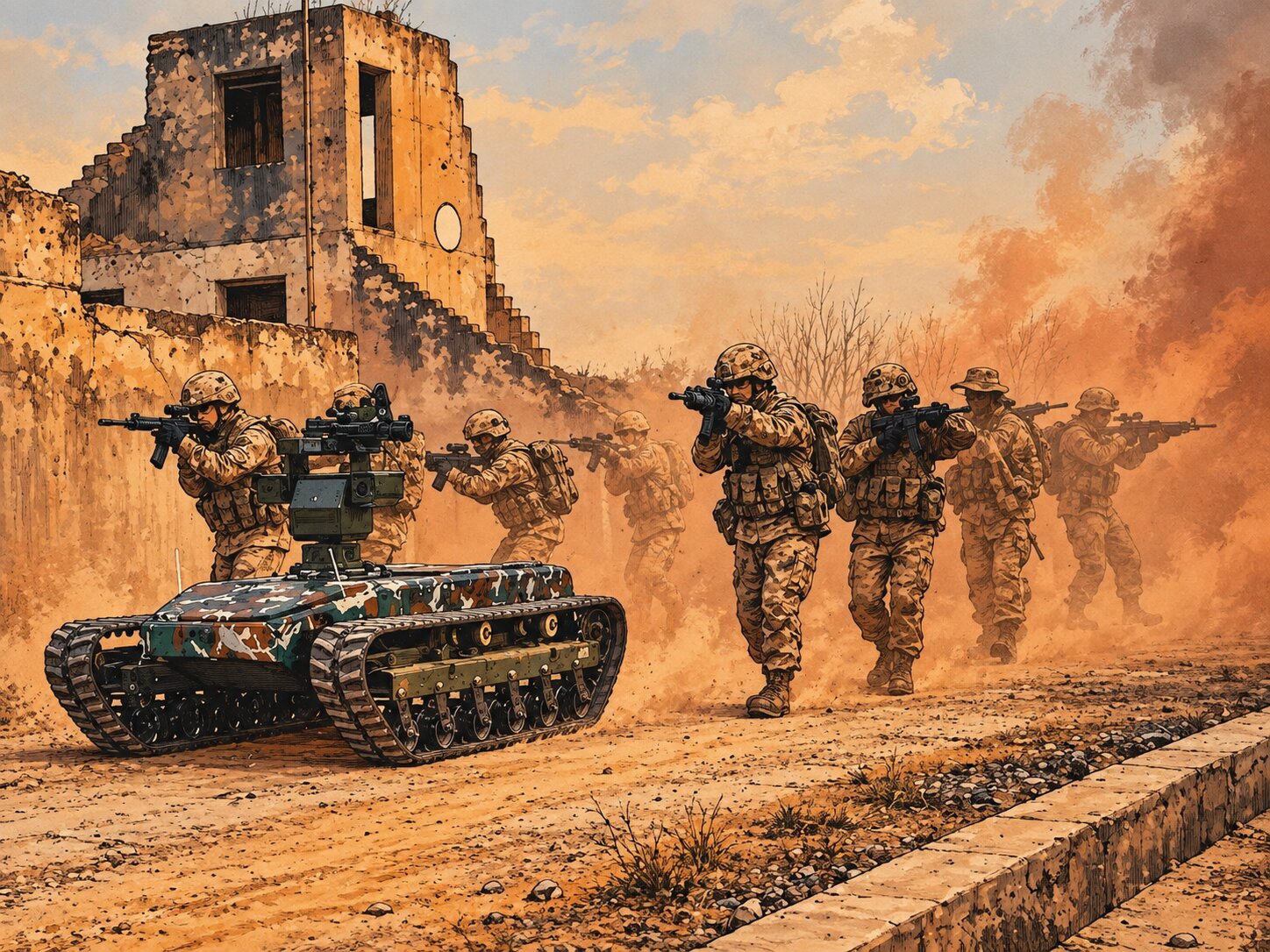
In July 2025, a unit of Ukraine’s 3rd Separate Assault Brigade received orders to take a Russian position in Kharkiv Oblast. No soldiers crossed the line of departure. According to some sources, four Targan 1K kamikaze UGVs from the Ukrainian company TarGun, each carrying 30 kg of explosives, struck the enemy bunkers. When a second wave of ground robots approached the damaged position, the surviving Russian soldiers held up a piece of cardboard with a message written in Russian: “We want to surrender.” An overhead drone guided them to Ukrainian lines. According to the brigade, no Ukrainian infantry was exposed and no casualties were sustained on the Ukrainian side. The prisoners were taken without a single soldier setting foot on the position.
For the first time in the history of warfare, a ground position was captured without a single soldier setting foot on it.
Ukrainian command logged it as the first documented case of a ground position seized exclusively by unmanned systems[1]. It marked something specific: the point at which ground robotics moved from logistical support tool to assault capable system, not in a test environment, not in a demonstration, but in a live combined-arms operation against a prepared defensive position. It also illustrated something broader: the operation was not won by a single platform, but by a system, aerial drones, ground robots and a command network operating as a coherent whole.
That this happened here, under these conditions, is not incidental. Ukraine became a front where human exposure had become unsustainable, where casualties were accumulating faster than units could absorb them, and where the political cost of losses had become a constraint on operational planning. Ground robotics did not emerge from a doctrinal vision but from necessity.
Is the battlefield already saturated from above?
Since 2023, aerial drones have progressively closed the air over contested terrain. They patrol up to 15 km behind the front line[2], hunt vehicles, and strike exposed personnel with enough consistency that open movement in daylight has become tactically indefensible in large stretches of the front. Logistics convoys that would previously have moved under fire suppression now require either armoured protection, night movement, or replacement by systems that do not put a driver at risk. The effect is not limited to the immediate front, it extends deep enough into the rear that the entire logic of ground supply has had to be rethought.
This is the condition that ground robotics entered. Not a clean slate, not a planned modernization program but a battlefield that had already been reorganized by aerial autonomy, and that was generating demand for ground equivalents by operational necessity rather than doctrinal design. What Ukraine compressed into three years of conflict, defence planners elsewhere are now beginning to formalize: superiority on the modern battlefield depends less on the intrinsic performance of individual platforms, and more on the ability to connect, produce and rapidly evolve integrated systems.
The difference is the operating environment. Aerial drones move fast, cover distance, and avoid terrain. Ground robots move slowly, carry more, and go where terrain requires them (buildings, along trench lines, across ground that aerial platforms can observe but not occupy). But proximity does not mean substitution. The more useful question is not which platform dominates, but what each one cannot do and whether the two together cover what neither can alone. Ukraine’s experience points towards a broader transition: from the procurement of individual unmanned platforms to the construction of integrated, interoperable and rapidly evolving systems of systems.
PART 1 – Technologies & Platform Architecture
UGVs cannot be understood through a single technological model. Their performance depends on mobility architecture, payload, endurance, communications and autonomy. Unlike aerial drones, ground systems must physically negotiate mud, rubble and obstacles while remaining operational under electronic warfare. Tracked, wheeled, legged and hybrid platforms therefore involve different trade-offs between speed, payload, mobility and endurance. Increasingly, these platforms are also designed as part of broader air-ground systems rather than as standalone vehicles. Understanding these technological foundations is essential to assessing where UGVs create operational value, and why no single architecture can address every battlefield requirement.
1.1. Air drones vs. ground drones: competition or complementarity?
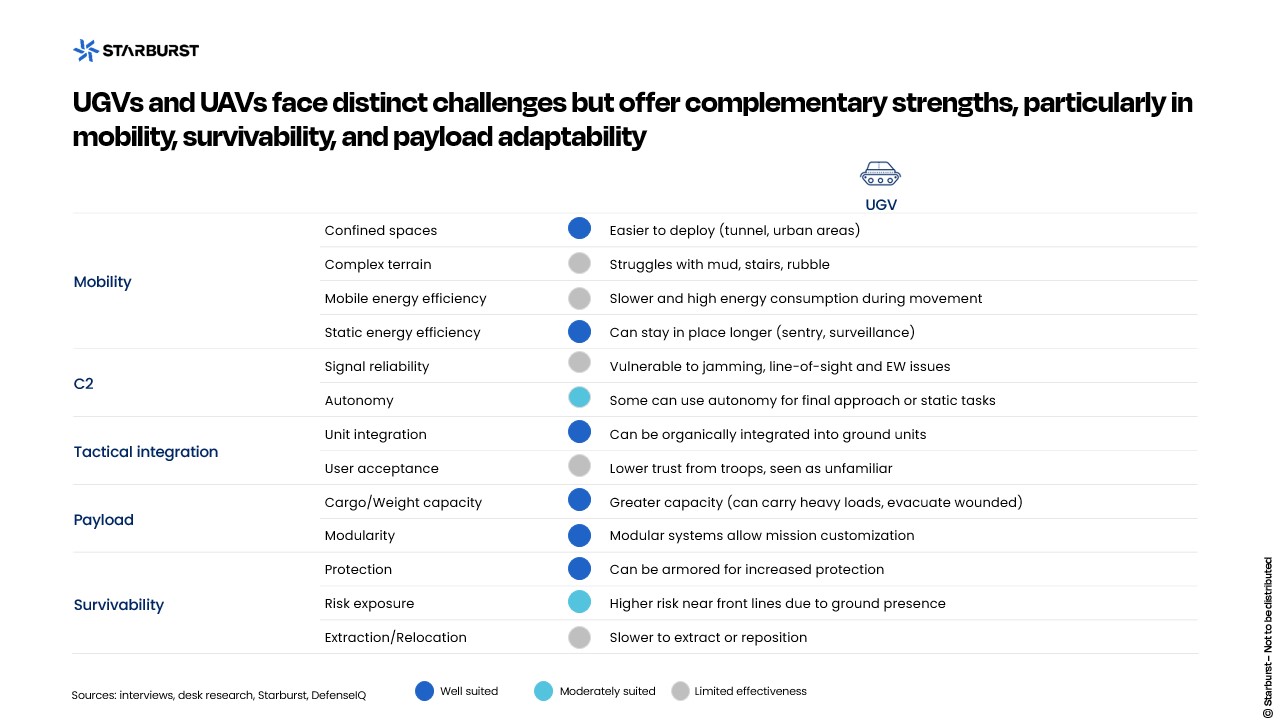
Given that aerial drones already dominate the contested space, what does a ground robot actually add? The honest answer is that the two platforms solve different problems and understanding where each fail is as important as understanding where each performs.
On mobility, the comparison cuts both ways. Aerial drones bypass terrain constraints entirely, they are unaffected by mud, rubble, or obstacles that can slow or stop ground platforms. However, their endurance is limited, they are more sensitive to adverse weather, and they often face greater challenges in GNSS-denied environments, degraded communications, and collision-prone confined spaces. Ground robots, by contrast, must contend with complex terrain such as stairs, steep gradients, or soft ground, but they can sustain operations for longer periods, carry heavier payloads, and maintain persistent presence in contested environments where endurance and reliable connectivity matter most.
On endurance and payload, the picture varies significantly by platform type. FPV drones and small multirotors operate for minutes; larger fixed-wing and VTOL systems can sustain flight for hours. The more structural difference is payload: aerial platforms remain constrained in what they can carry and cannot hold a position under load. Ground robots are slower and consume more energy during movement, but they can carry heavy loads, remain stationary without burning fuel, and evacuate casualties in a way no aerial platform can.
Command and control is where both platforms face their most significant shared vulnerability. Both are susceptible to jamming, both depend on datalinks that degrade in electronically contested environments. The difference is that aerial drones have developed more advanced autonomous navigation with greater reliability than current ground systems. UGVs have compensated partly through fiber-optic tethered control, which defeats jamming entirely but constrains range[3]. Neither solution is satisfactory for sustained high-intensity operations; both represent workarounds to a problem that autonomy research has not yet fully solved.
On tactical integration, UAVs have the advantage of familiarity. They have been in operational use long enough that doctrine, training and user acceptance are established. UGVs are newer, less trusted by the troops who would use them, and harder to integrate organically into ground unit structures. This is not a technical limitation but an adoption curve.
The result is a market that reflects these asymmetries. UAVs currently represent the dominant share of the uncrewed systems market, with UGVs accounting for a fraction of total revenues despite their growing operational relevance[4]. That ratio is not primarily a function of capability but a function of maturity, trust and the accumulated weight of a decade of aerial drone adoption. The gap is narrowing, not because ground robots have suddenly become better, but because the operational problems they solve have become more acute.
What has emerged in Ukraine, and what the US Army is formalizing through its Project Convergence exercises[5], is not a choice between air and ground autonomy but a layered architecture: aerial platforms for overwatch, targeting and strike; ground platforms for supply, casualty evacuation, position-holding and close combat support. The integration between them with shared sensor data, coordinated tasking, unified command is where the current work is happening. It also points to a broader structural shift: from platform logic to system-of-systems logic, where aircraft, drones, sensors, effectors, C2 and software must be conceived as a coherent, interoperable and evolvable ensemble rather than discrete procurement programs.
The soldier has not left the battlefield. What has changed is where in the operational sequence human presence is required.
Most UGVs in operational use today are teleoperated. An operator controls the platform remotely and makes the decisions that matter when to move, what to engage, when to stop. The robot provides physical presence at the point of risk; the human provides judgment from a position of relative safety. This is not autonomy in any meaningful sense. It is a reallocation of exposure.
The transition toward greater autonomy is real but uneven.
1.2 A two-axis framework to map the market
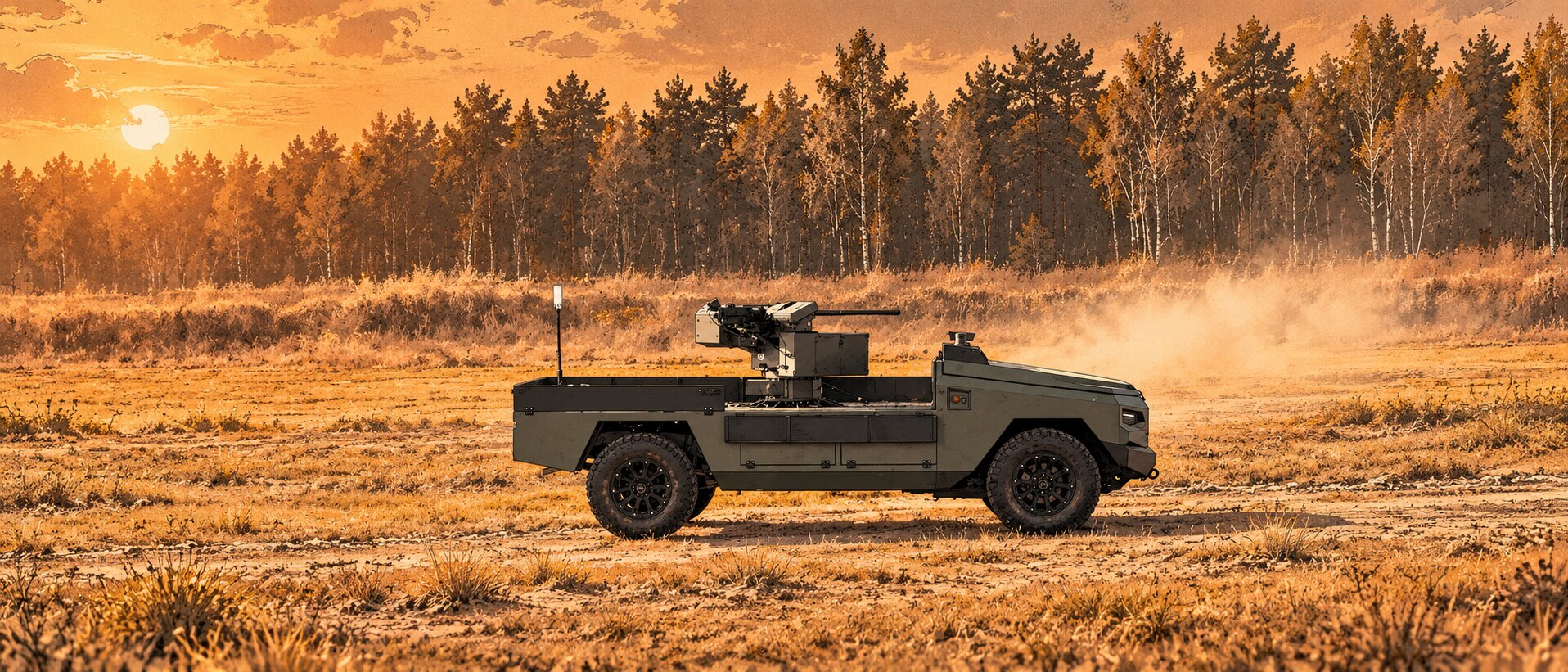
The UGV market is best understood through two structural axes. The first is weight, from sub-10 kg scout robots to armored systems exceeding 2,000 kg. The second is locomotion.
These two dimensions together determine what a platform can do on a battlefield, and where it fits competitively.
Wheeled platforms: range, speed and maintainability
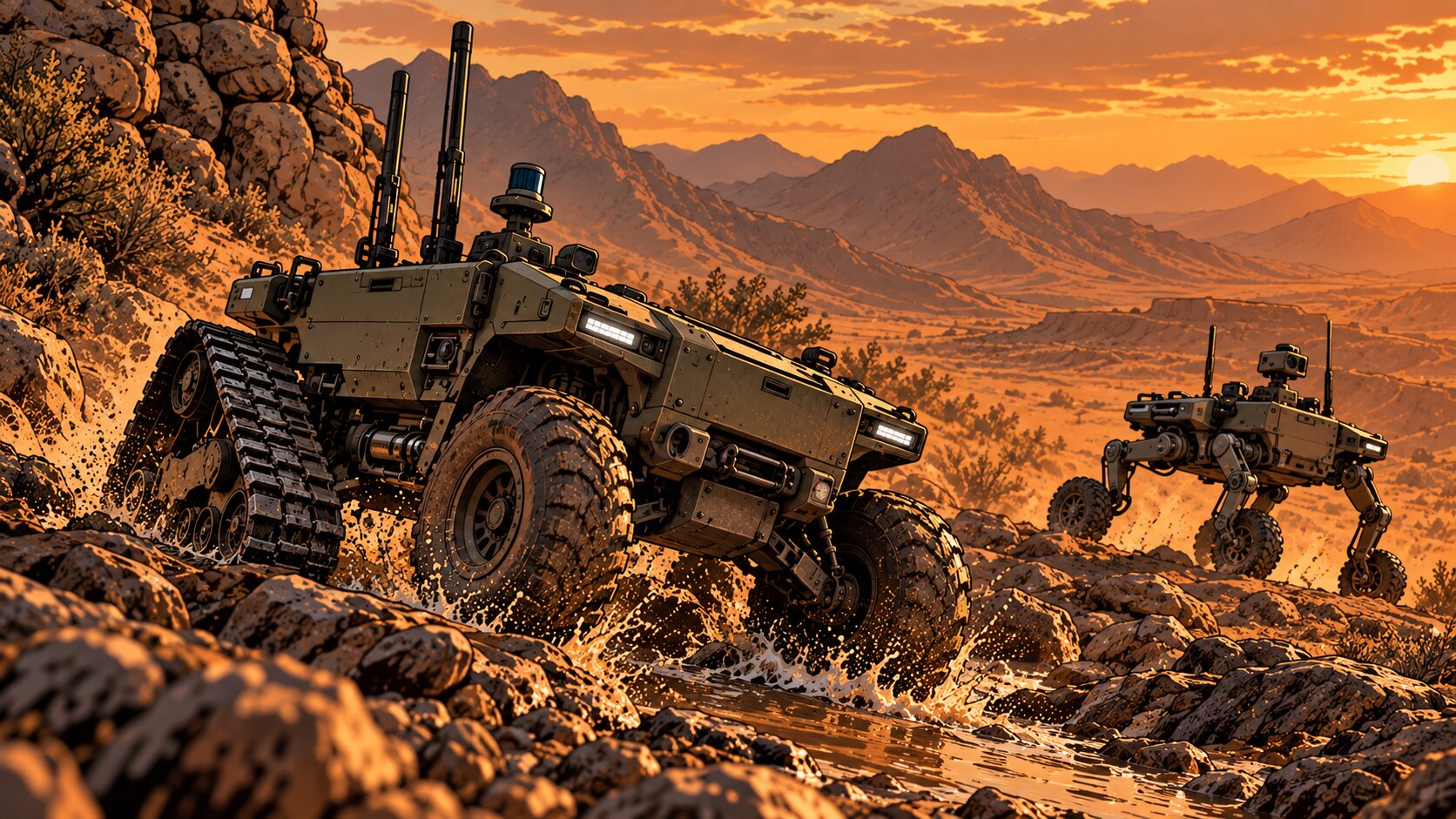
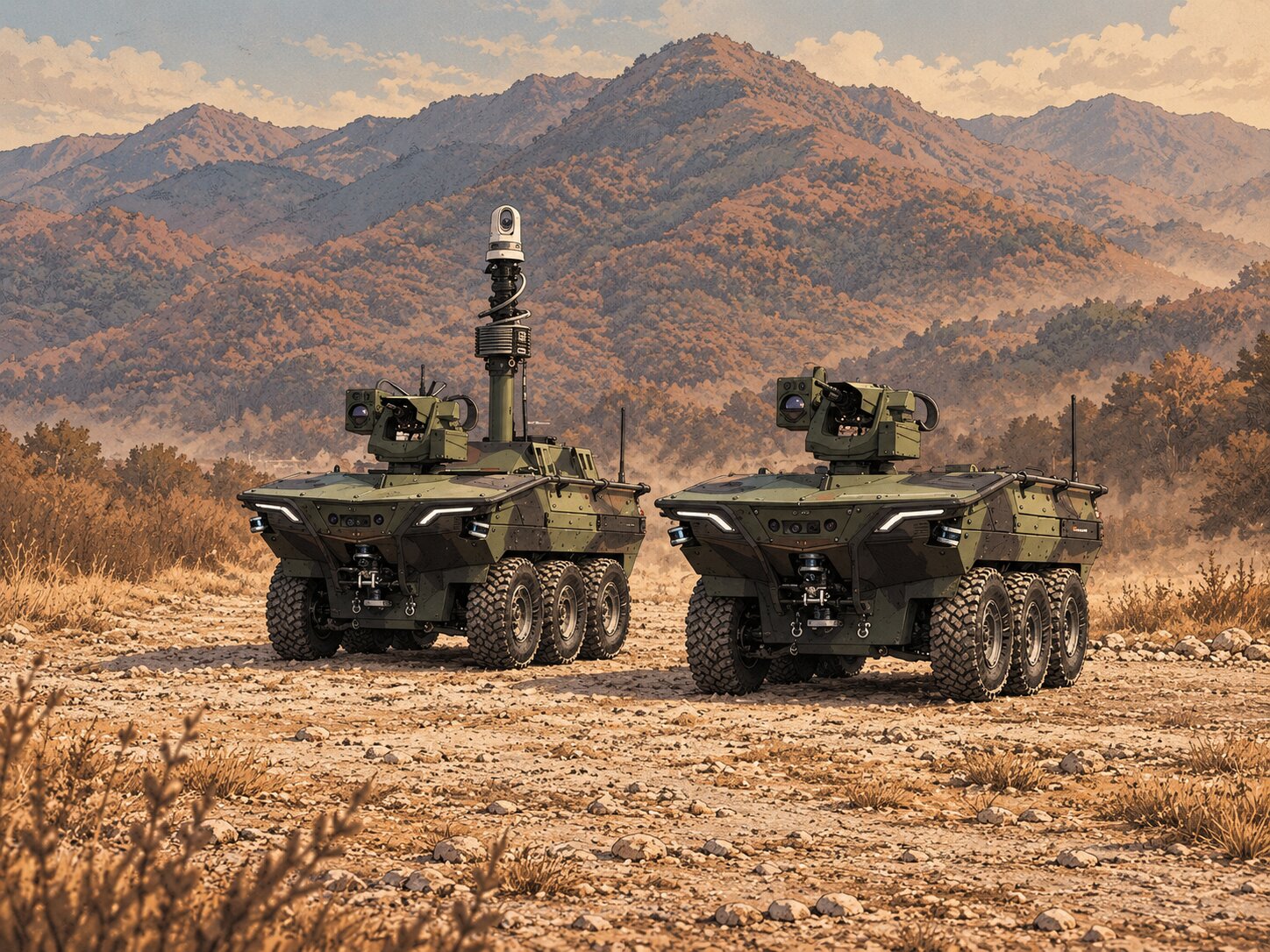
Wheeled platforms trade cross-country capability for range, speed and affordability. They dominate ISR, patrol and convoy-follow roles. Rheinmetall’s Mission Master CXT covers 450 km on a single load with 1,000 kg of payload; its smaller sibling the Mission Master SP is optimized for low-signature dismounted support. NORINCO’s Sharp Claw II (6×6) and Arquus’ DRAILER (750 kg payload, hybrid-electric) follow the same pattern: fast, flexible, and designed for prepared terrain. However, wheeled platforms lose much of their speed and payload advantage on soft ground, mud, rubble or steep gradients, which limits their utility in the degraded environments that define high-intensity conflict. Ukraine’s experience confirms that tracked platforms have systematically replaced wheeled systems for frontline logistics precisely because the terrain conditions made wheels unreliable.

Legged platforms: access to terrain that conventional chassis cannot negotiate
Legged platforms (robot dogs and quadrupeds) are the fastest-growing segment, driven largely by China. Their structural advantage is decisive in one specific environment: anywhere wheeled and tracked robots fail (stairs, rubble, narrow urban passages, uneven mountain terrain). Unitree’s B2 carries over 40 kg at 6 m/s for more than 5 hours. China South Industries’ RoboWolf operates in clusters of up to 30 units with air-ground coordination capability. The cost point is equally disruptive: Chinese military quadrupeds are reported at roughly one-twelfth the cost of US equivalents. The tradeoff is endurance: legged platforms are entirely battery-powered by design because thermal engines are incompatible with the mechanical precision their joints require, capping operational autonomy at 3 to 5 hours, against 15 hours or more for hybrid tracked systems. This makes them well-suited for discrete, time-bounded missions rather than sustained operations.
Tracked platforms: traction and payload at the cost of speed and complexity
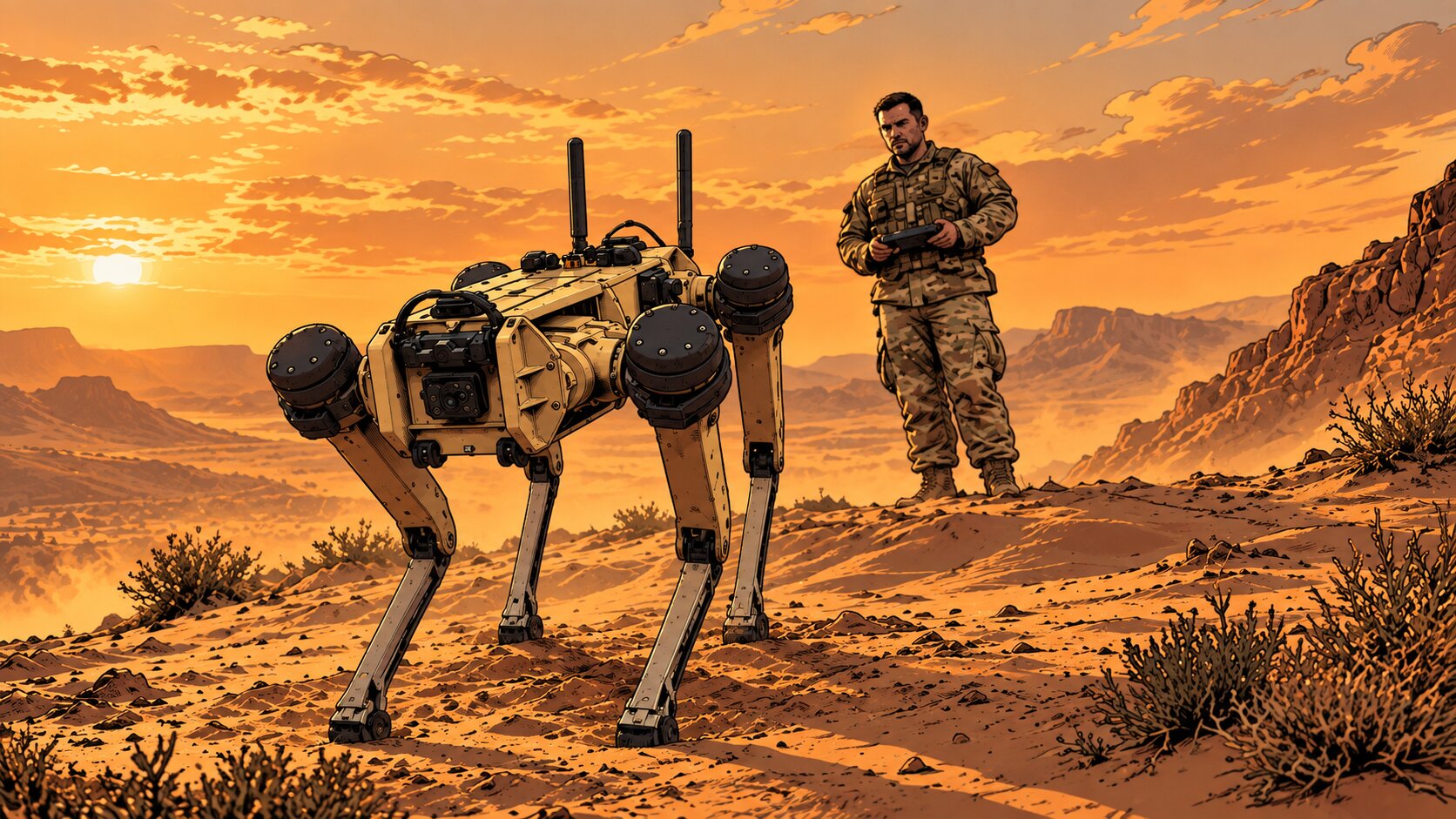
Tracked platforms are the workhorses of the heavy and medium segments. Their cross-country mobility and high payload capacity make them the default choice for sustained operations in degraded terrain. The Milrem THeMIS, the world’s most widely deployed UGV with 20 customers, weighs 1,630 kg and carries up to 1,200 kg of payload over 15 hours of hybrid endurance[6]. Ukraine’s frontline platforms follow the same logic: the RATEL H carries 600 kg of supplies, the TerMIT has sustained logistics for frontline units for up to six weeks without interruption[7]. The tradeoff is speed and cost, tracked systems are slower and more expensive to produce than their wheeled counterparts.
At the lighter end of the tracked segment, Ukraine’s Spider system illustrates a different design philosophy. Codified for use by the Ukrainian Defence Forces in 2025, the compact platform is available several configurations, including logistics and engineering-support variants. Two systems can be transported in the cargo bed of a standard military pickup, highlighting the importance of tactical deployability, low logistical burden and rapid replacement in the Ukrainian model[8].
Hybrid morphologies: promising but not yet a distinct market segment
Hybrid platforms combining wheels with adaptive tracks, or wheels with legs are emerging but remain marginal for now.
PART 2 – Use case: An expanding matrix
UGVs are moving far beyond their original roles in reconnaissance and explosive ordonance disposal. Battlefield experience, particularly in Ukraine, has accelerated adoption across logistics, casualty evacuation, combat support and counter-UAS missions. This expansion is driven by a common objective: reducing human exposure while maintaining physical presence on the ground. Yet each mission creates different technical requirements, from payload and endurance to stability, survivability and low signature. The UGV market is therefore best understood as an expanding matrix in which mission, platform architecture and payload increasingly shape one another.
The conventional logic held that light platforms served ISR (Intelligence, Surveillance and Reconnaissance) and route clearing, while heavier systems handled transport, logistics and combat. That logic still broadly holds, notably in Ukraine, but the operational spectrum has expanded significantly since 2025.
- ISR is the original UGV mission and remains one of the most active segments. Small, low-signature platforms are sent ahead of troops to gather real-time intelligence on enemy positions, terrain and threats, reducing the exposure of soldiers during the most dangerous phase of any ground operation. The combination of optical, thermal and LiDAR sensors on even low-cost platforms has made UGV-based ISR accessible to a wide range of militaries, driving a highly competitive market with many players at the light end of the weight spectrum.
- Route clearing and EOD (Explosive Ordonance Disposal) principle is simple: send a robot into an environment suspected of containing IEDs, mines or unexploded ordonance before exposing personnel. Ukraine’s RoverTech illustrates how the EOD segment is evolving from remotely controlled machinery into purpose-built robotic mine-action systems. Its ZMIY platform has passed official conformity testing and is designed to destroy anti-personnel and anti-tank mines while also removing tripwires. The system’s relatively lightweight and remotely operated design is intended to reduce personnel exposure while providing a lower-cost alternative to traditional heavy mine-clearance vehicles[9]. Dropla Tech represents a complementary approach to mine action. Rather than focusing exclusively on mechanical clearance, the Danish-Ukrainian company combines UGVs, aerial systems, artificial intelligence, computer vision and sensor-fusion software to detect, map and classify explosive hazards before clearance assets are deployed. Its UGV solutions have been tested by Ukraine’s State Emergency Service and State Transport Special Service. It is a mature, high-barrier segment, but also the one most directly validated by the density of minefields in Ukraine, which has created renewed procurement urgency across NATO[10].

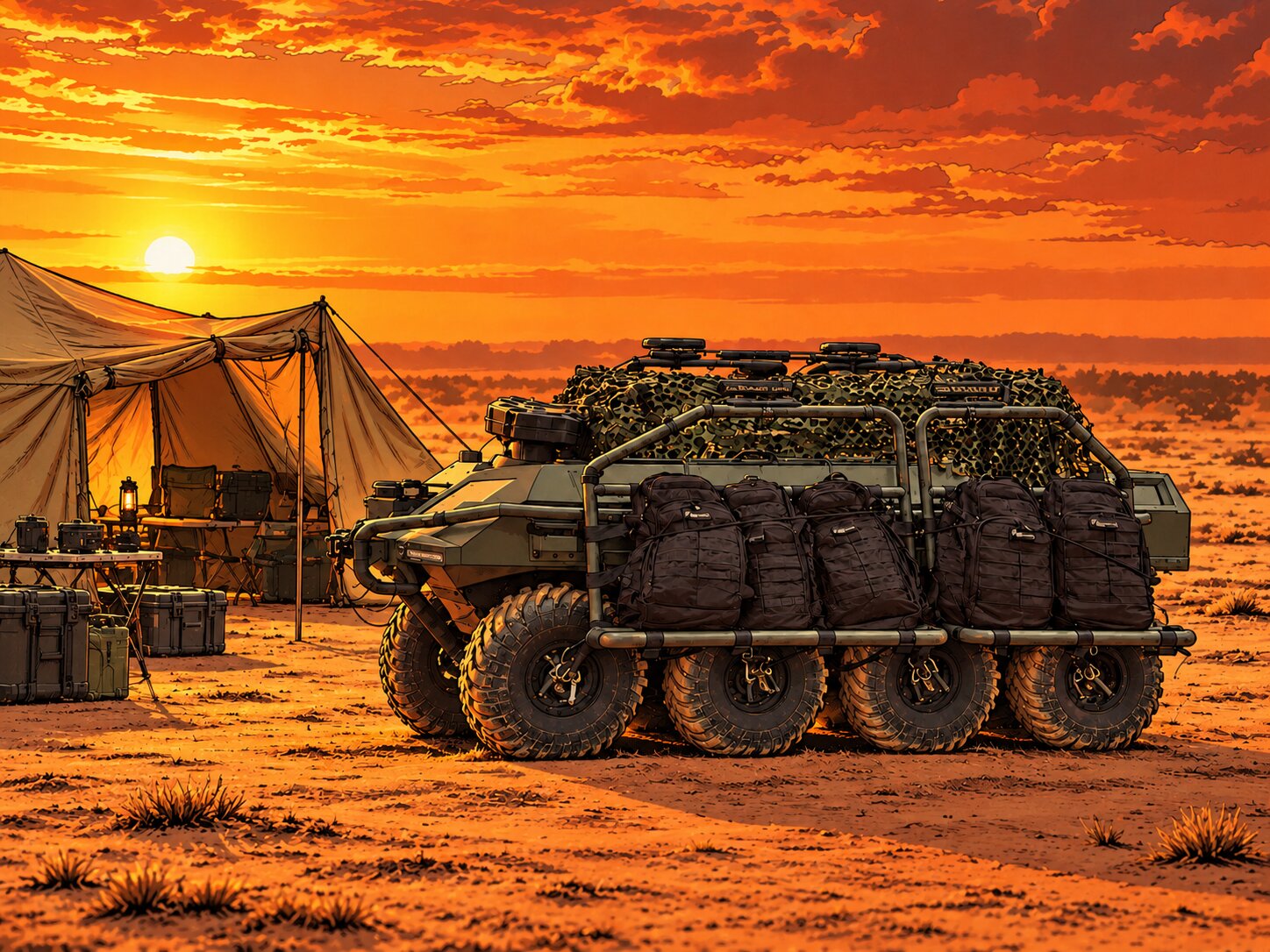
- Transport and logistics cover the movement of supplies (ammunition, food, medical material, etc.) from rear staging areas to forward positions. It is the use case that has scaled most dramatically in Ukraine, driven by a specific tactical reality: FPV drones now patrol contested zones up to 15 km deep, making conventional vehicle logistics on the last stretch of the supply chain lethal[11]. Medium tracked platforms like the RATEL H (600 kg payload) and TerMIT have replaced human-driven vehicles for this mission, with the TerMIT sustaining logistics for a frontline unit continuously for six weeks. The US Army has formalized this requirement with a competitive solicitation issued in April 2026 for an autonomous “last tactical mile” UGV, GPS-denied, low-signature, integrated into military networks[12]. Ukraine’s logistics UGV market now covers a broad operational spectrum. Trinity Robotics’ KONYK ONE and Roboneers’ Lynx address last-mile delivery and casualty evacuation with platforms designed for transportability and field repair. BUREVII’s compact ARDAL combines logistics, mining and casualty-evacuation missions, while Ukrainian Armor’s PROTECTOR moves into a heavier category capable of sustained frontline resupply and the integration of specialised mission systems.
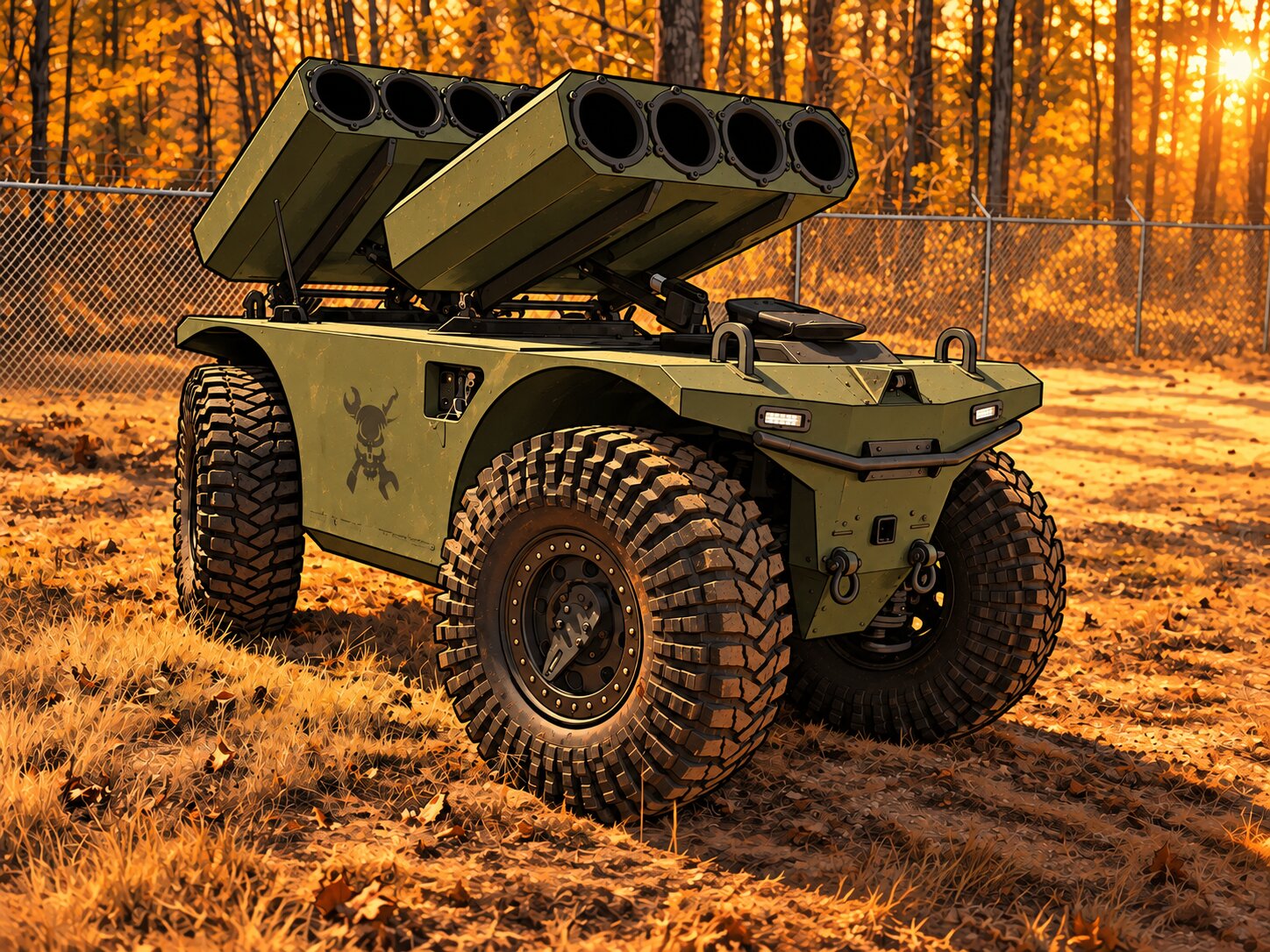
- Combat has moved from theoretical to operational faster than most analysts anticipated. Armed UGVs are now being used for direct fire support, position holding and offensive action. The DevDroid TW 12.7, a $26,000 tracked platform with a NATO-standard .50-caliber machine gun, held a position against Russian attacks for 45 days in late 2025, the first documented case of a ground position held exclusively by an unmanned system. President Zelensky announced that Ukraine had captured a Russian position using only unmanned platforms[13]. Combat UGV development is also becoming increasingly modular and cross-company. Roboneer’s SabLynx family combines a common Lynx mobility platform with several remote weapon configurations, including machine-gun and automatic-grenade-launcher variants. Separately, BUREVII and Frontline Robotics have integrated the Mk 19-armed Buria remote turret onto the ARDAL UGV, creating a mobile system combining fire support, logistics and evacuation functions[14]. The future competitive landscape may therefore be structured less around complete, vertically integrated platforms and more around ecosystems of interoperable chassis, effectors, sensors, communications systems and control software.
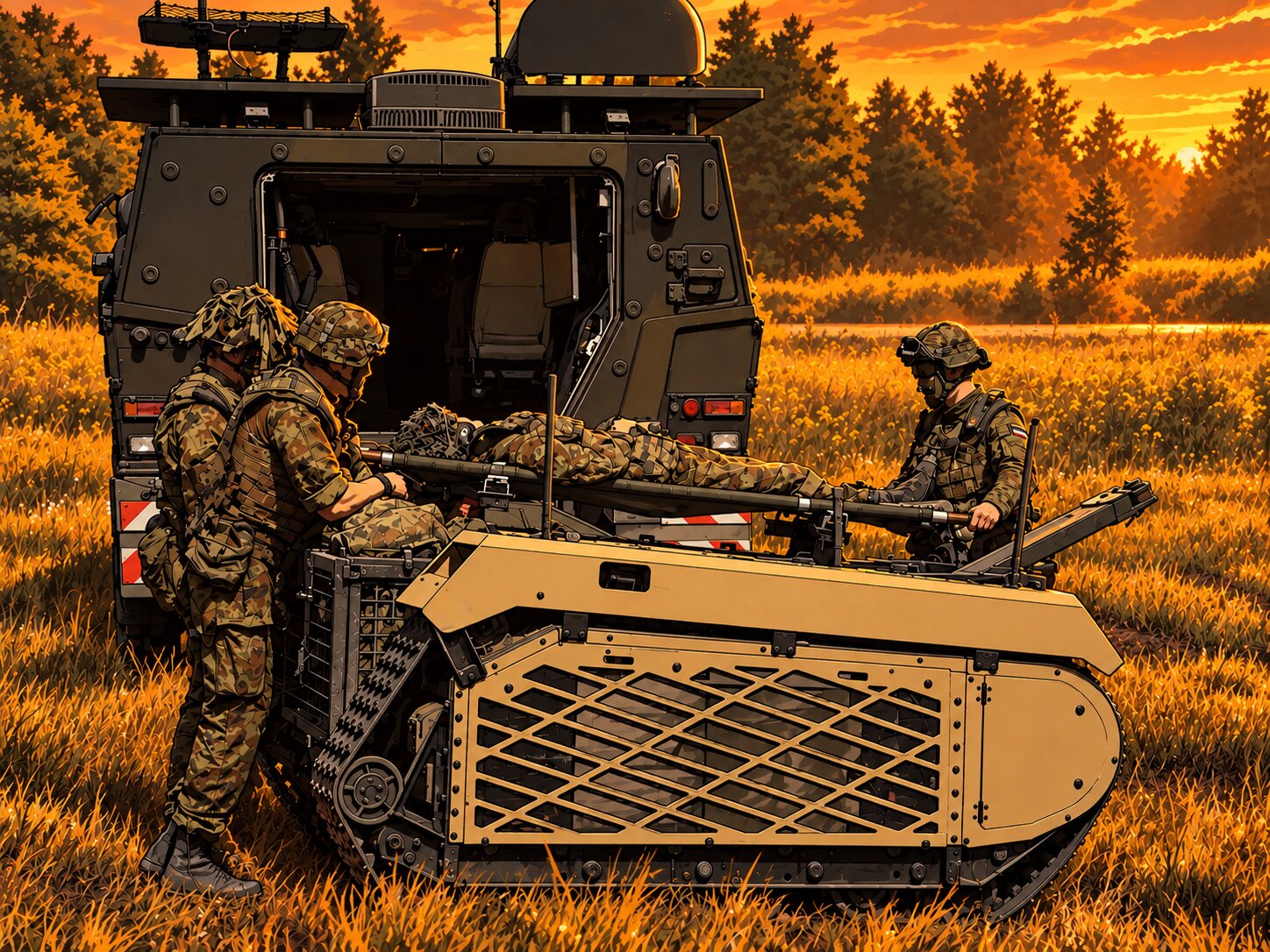
- CASEVAC (Casualty Evacuation) has emerged as one of the most operationally significant new use cases. Ground robots are used to extract wounded soldiers from the grey zone where aerial evacuation is impossible and sending personnel creates additional casualties. Ukrainian units have conducted CASEVAC missions over distances of up to 34 km using UGVs. The 1st Separate Medical Battalion is among the units cited for the highest number of completed robotic CASEVAC missions in March 2026[15]. This use case places specific demands on platforms: stable low-speed movement, sufficient payload for a stretcher and casualty, and reliable operation under EW interference. BUREVII’s ARDAL provides a documented a documented example of this mission. During one four-day period, the platform supported four successful evacuations of wounded personnel for the K-2 Regiment, including the extraction of a critically injured soldier from an area inaccessible to personnel. The mission also demonstrates the importance of air-ground cooperation: a reconnaissance UAV was used to adjust the UGV’s route in real time[16].
- C-UAS (Counter-Unmanned Aerial Systems) is the newest and fastest-growing use case, born directly from the drone-saturated environment of the Ukraine conflict. The logic is straightforward: if FPV drones are the primary threat to ground operations, a mobile ground platform dedicated to detecting and neutralizing them offers persistent, terrain-following protection that fixed installations cannot provide. Ukrainian forces have already deployed UGVs armed with machine guns to engage FPV drones over Kramatorsk[17]. At the institutional level, KNDS unveiled at Eurosatory 2026 a dedicated EW/C-UAS module for the THeMIS, integrating a 360° radar, an RF scanner, a digital jammer and a GNSS spoofing device[18].

PART 3 – Players & Strategic Models: Three doctrines, three logics
The competitive landscape of the UGV market is best understood not as a single global race but as three parallel competitions, each operating on a fundamentally different theory of what a ground robot is for.
3.1 The established NATO-market model: integration and lifecycle value
The NATO model is built on the premise that a UGV is a high-value, multi-mission asset that needs to survive, be recovered and be reused. This shapes everything: the modular architecture that allows a single platform to switch between logistics, ISR and combat roles; the hybrid propulsion systems designed for endurance over range; the open C2 interfaces built for integration into existing battle management systems. The business model follows the same logic: long procurement cycles, institutional customers, certified systems, and post-sale support contracts that often exceed the platform price. Milrem’s THeMIS is the clearest expression of this model with government or direct defense contracts. The implicit bet is that most armies will not replace their existing vehicle fleets but will want to make them semi-autonomous, a much larger addressable market than purpose-built UGVs alone. The US Army’s decision in August 2025 to fund three autonomy startups (Overland AI, Forterra and Scout AI)[19] to develop self-driving kits for the Infantry Squad Vehicle suggests the same conclusion is being reached on the procurement side.
3.2 The Ukrainian model: battlefield iteration and attritable scale
Ukraine represents a direct challenge to that model not by competing on the same terms, but by demonstrating that a different set of assumptions can produce operational results at a fraction of the cost. The Ukrainian approach starts from a different premise: a UGV is a mission-specific, attritable and field-repairable systems designed for rapid iteration, not an asset. At $6,000 to $100,000 per unit, platforms are expected to be lost, damaged and replaced rather than recovered and repaired. This tolerance for attrition changes the design logic entirely: simplicity, repairability and rapid iteration matter more than modularity and long-term versatility. The Brave1 ecosystem, which grew from zero to more than 2 000 companies in three years, with 175 grants issued to developers[20], is structured around exactly this feedback loop: developers receive grants, deliver platforms to frontline units, get direct operational feedback within weeks, and iterate. The result is a development cycle that compresses what would take Western primes years into months. What Ukraine has proven is not just that cheap UGVs work, it is that a decentralized, fast-cycle industrial model can outpace centralized procurement in an environment where the threat evolves faster than any acquisition process can follow. By 2026, Ukraine’s UGV model was beginning to move beyond decentralized domestic wartime production. Tencore and Quantum Systems established Quantum Tencore industries to manufacture 2,000 TerMIT systems in Germany for the Ukrainian Armed Forces[21]. Roboneers and Germany’s ARX Robotics created ARX Industries to scale production of the Lynx PRO platform in Germany and Ukraine[22]. DevDroid and KONGSBERG signed a memorandum covering the production of existing remotely operated combat systems and the joint development of future solutions[23]. Trinity Robotics also announced plans to double annual output to approximately 2,200 systems while exploring production cooperation with an unnamed French industrial partner[24].
3.3 The Chinese model: industrial depth and coordinated formations
China’s logic is different again, and in some ways more disruptive than either. Where the West optimizes for individual platform capability and Ukraine for attrition economics, China is building toward mass and coordination. The underlying doctrine points toward swarm employment: large numbers of low-cost platforms operating in concert, sharing sensor data, coordinating movements and overwhelming adversary defenses through volume rather than individual sophistication. In practice, what China has demonstrated so far is closer to coordinated air-ground and manned-unmanned teaming than true autonomous swarm operation: the 480-unit robotic cluster displayed at the “9·3” parade in 2025 was not a demonstration of a single capable system, it was a demonstration of what happens when you treat ground robots the way you treat ammunition though it remains an experimental demonstration rather than a proven operational doctrine[25]. This doctrine requires a very specific industrial base: extremely low unit costs, high-volume production capacity, and software that can coordinate hundreds of units simultaneously. NORINCO and China South Industries provide the military-grade platforms; Unitree and the broader civilian robotics ecosystem, which produces quadrupeds at $1,600, provide the cost floor and the technology pipeline[26]. The boundary between civilian and military development is deliberately blurred, allowing the Chinese military to absorb commercial innovation at a pace that Western export controls and procurement regulations cannot easily counter.
3.4 UGV Competitive Landscape by Platform Type and Mission
The trajectory seems clear but translating battlefield momentum into sustained operational capability at scale raises a distinct set of structural challenges that the market has not yet resolved.
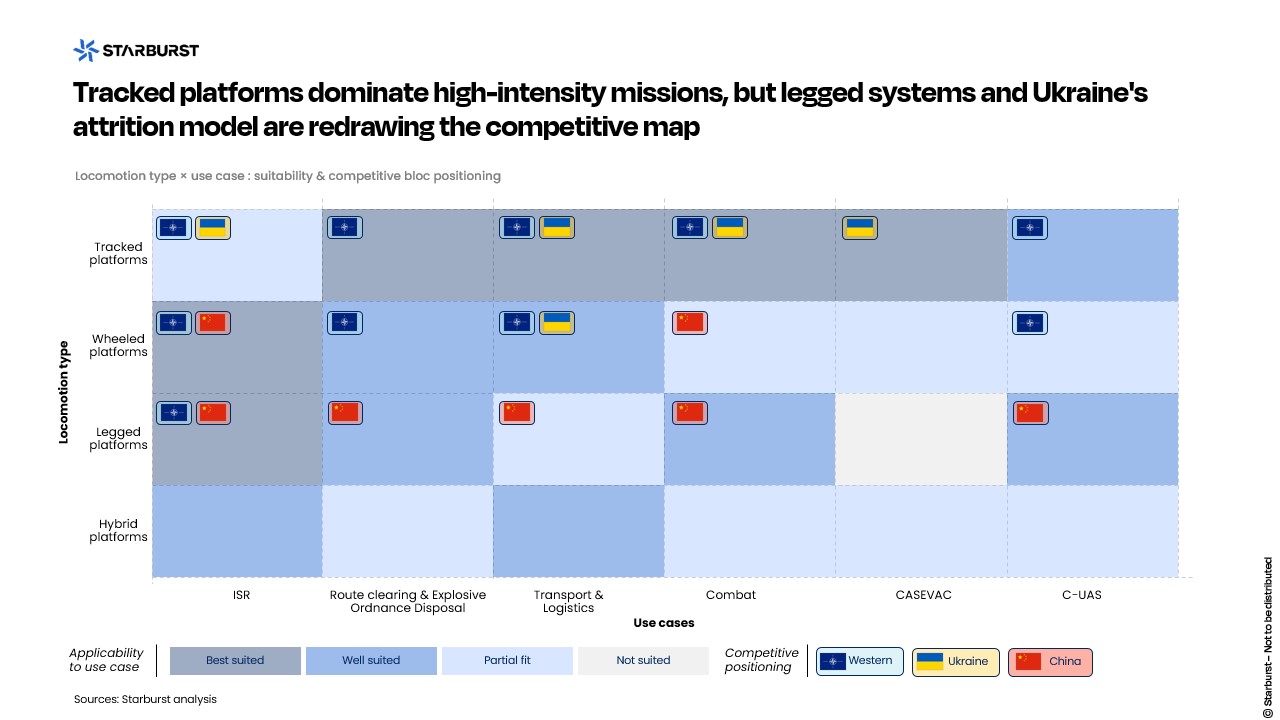
PART 4 – Competitive Landscape: A fragmented market structured by platform type and mission
The UGV market remains highly fragmented, with no single platform or player dominating across missions. Tracked and wheeled systems currently offer the broadest coverage, while legged platforms remain more specialised and hybrid architectures are still emerging. Competition also varies by player type, from established defence groups to robotics specialists and fast-moving Ukrainian manufacturers. As hardware architectures mature, differentiation is likely to shift increasingly towards autonomy software, operational data, payload integration and the ability to rapidly incorporate battlefield feedback.
The types of players and primary applications vary according to the locomotion type and use cases
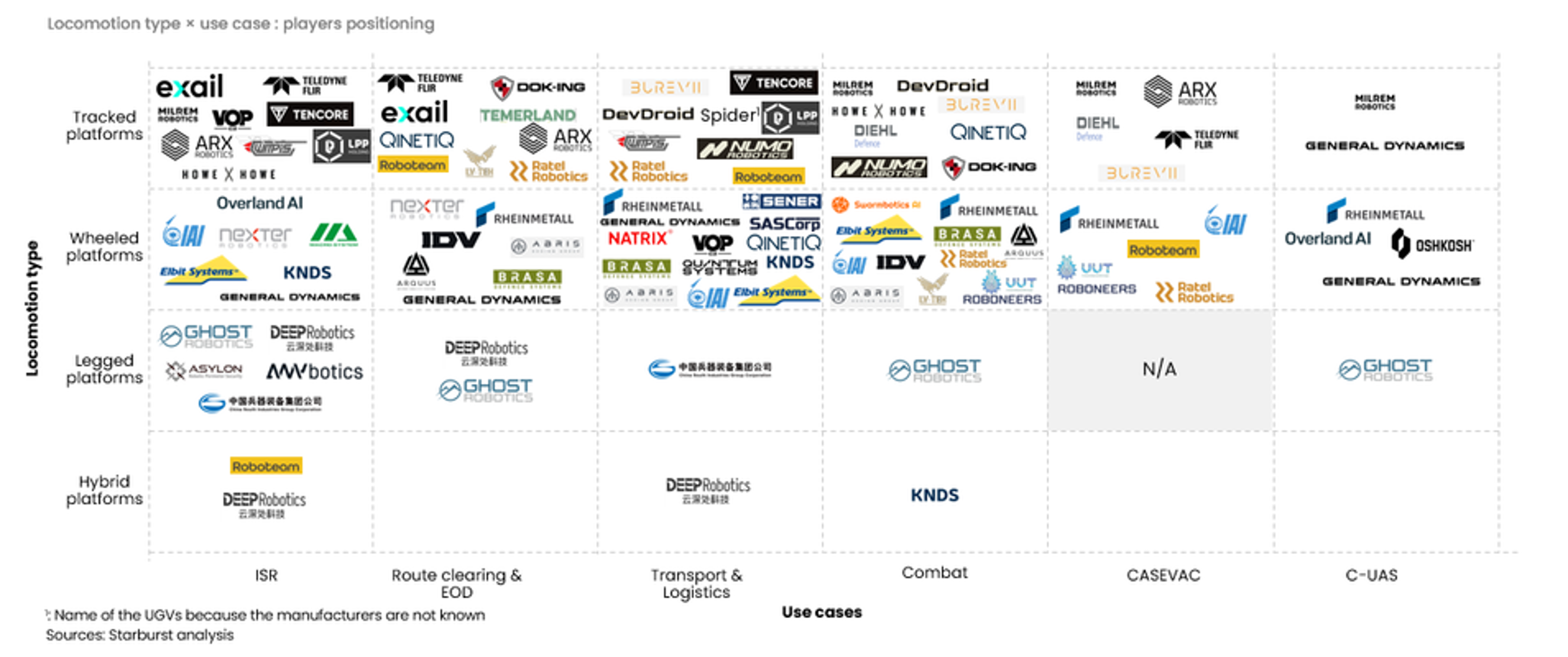
The UGV landscape remains highly fragmented, with no single platform architecture or category of player dominating across all operational missions. The mapping shows that competitive positioning is shaped by the intersection of two dimensions: locomotion type and use case.
Tracked and wheeled platforms account for the broadest market coverage. Both architectures are represented across ISR, route clearance, logistics, combat and casualty evacuation, reflecting their relative maturity and ability to carry modular mission payloads. Tracked systems are particularly visible in logistics, combat and CASEVAC, where traction, stability and payload capacity are important. Wheeled platforms show similarly broad coverage, with a stronger presence in missions where speed, range and simpler sustainment are advantageous.
Legged platforms remain concentrated around ISR and specialised combat-support applications. Their value lies primarily in accessing stairs, rubble, buildings and other environments that conventional chassis struggle to navigate. Their more limited presence in logistics and evacuation reflects current constraints in payload, endurance and operational maturity.
Hybrid morphologies remain marginal. Although wheel-leg and wheel-track concepts may offer advantages in obstacle crossing, they have not yet developed into a clearly established market segment.
The mapping also highlights differences between player types. Established defence groups are active primarily in medium and heavy wheeled or tracked platforms, often addressing several missions through modular payload integration. Specialist robotics companies are more visible in ISR, EOD, autonomous mobility and lighter platform segments. Ukrainian manufacturers are represented across a particularly wide range of missions, reflecting the rapid adaptation of platforms to frontline logistics, combat and evacuation requirements.
The strongest concentration of actors is found in ISR, route clearance, logistics and combat. CASEVAC remains more specialised, despite its growing operational importance, while mobile C-UAS represents a comparatively emerging segment with a smaller number of identified systems.
Overall, the market appears to be evolving less towards one universal UGV than towards a portfolio of platforms optimised for different combinations of terrain, payload and mission. The competitive advantage of manufacturers will therefore increasingly depend on their ability to reuse common chassis, software and control architectures across several applications without compromising mission-specific performance.
Interviews conducted by Starburst suggest that physical UGV architectures may progressively converge around a smaller number of reliable wheeled and tracked configurations. If this occurs, differentiation would shift increasingly towards autonomy software, operational data, payload integration and the speed at which manufacturers can incorporate battlefield feedback into deployed systems.
PART 5- Scaling Challenges: What Still Limits UGV Deployment?
The battlefield relevance of UGVs is no longer in question. Between January and early June 2026, Ukrainian forces reported more than 50,000 logistics and casualty-evacuation missions using ground robotic systems[27]. The challenge is now to transform this rapid operational adoption into a reliable and scalable military capability.
Unlike UAVs, ground robots must operate simultaneously in two hostile environments: the physical battlefield of mud, rubble, mines and obstacles, and the digital battlefield of jamming, disrupted communications and cyber threats. Progress in one dimension cannot compensate for failure in another. A sophisticated payload provides little value if the platform cannot cross the terrain, maintain control or be repaired in the field.
5.1 Terrain remains the defining constraint
For UAVs, terrain is primarily a navigation issue. For UGVs, it is a permanent physical constraint.
A ground robot must not only detect an obstacle but determine whether its specific chassis can cross it. Vegetation may conceal a ditch or mine; a puddle may be shallow water or deep mud; and a route that appears accessible from the air may be impassable because of soil conditions, shell craters or vehicle tracks.
This is why civilian autonomous-driving technology cannot simply be transferred to the battlefield. Commercial vehicles generally operate on mapped and structured roads. Military UGVs must navigate unpredictable off-road environments, frequently without GNSS or reliable maps.
DARPA’s RACER programme demonstrated significant progress, developing a platform-agnostic autonomy stack capable of navigating complex terrain without GPS or pre-mapped routes. Yet such demonstrations do not mean that reliable autonomy has been achieved across every combination of terrain, weather, visibility and vehicle configuration[28].
The relevant performance metric is therefore not autonomous speed on a test track, but mission-completion reliability across representative terrain. Large volumes of operational data linking perception to vehicle-specific traversability will be essential.
5.2 Connectivity must be designed to fail safely
Electronic warfare affects all unmanned systems, but UGV communications face an additional disadvantage: the robot operates close to the ground. Buildings, vegetation, trenches and small changes in elevation can rapidly break radio line of sight.
Current Ukrainian designs illustrate the need for communications redundancy. The Bizon-L, for example, incorporates six possible communications channels, including LTE, Wi-Fi and Starlink[29]. This does not eliminate the problem; it reflects the reality that no single link can be expected to remain available throughout a contested mission.
Fleet fragmentation creates another constraint. A unit operating logistics, ISR and armed UGVs from different manufacturers may require several controllers, radios and software interfaces. This increases training requirements and makes mixed-fleet operations difficult.
Communications loss must therefore become a normal operating condition rather than an exceptional failure. Platforms should be capable of continuing along a stored route, avoiding local obstacles, returning to a safe location or stopping securely without constant operator input. At the fleet level, open interfaces and common data standards will be critical to avoid vendor-specific robotic silos.
5.3 Removing the crew does not remove the target
UGVs reduce human exposure, but they remain slow and observable systems operating within the enemy’s engagement zone. They can trigger mines, become immobilised by terrain and be detected by aerial reconnaissance or FPV drones. Once stuck, a robot quickly becomes a stationary target.
A reported Ukrainian CASEVAC mission near Pokrovsk illustrates how these vulnerabilities compound. A Bizon UGV was sent along a heavily mined route under persistent enemy drone observation. During the evacuation, an FPV drone struck the platform and communications were temporarily lost. The casualty nevertheless survived and reached friendly lines.
Simply adding armour is not a sufficient answer. Additional protection increases weight, ground pressure and energy consumption while reducing mobility and making recovery more difficult. The same trade-off applies to batteries and payloads: every additional kilogram affects endurance, traversability and the platform’s ability to escape degraded terrain.
Survivability must consequently be addressed at system level through signature reduction, route variation, night operations, UAV-supported threat detection, reduced radio emissions and modular protection. The objective is not necessarily to make every UGV survivable, but to ensure that its cost and operational effect justify the risk of losing it.
5.4 Every disabled UGV creates a recovery problem
Attritable does not automatically mean disposable.
A small UAV may be abandoned after a crash. A 300-kilogram logistics UGV carrying expensive sensors, encrypted communications equipment, or a casualty, cannot always be treated in the same way. A breakdown near the front may require soldiers or another robotic system to enter the contested area to recover it. Capture can also expose sensitive software, radios and autonomy capabilities.
Sustainment must therefore be designed into the platform from the beginning. Common batteries, interchangeable payloads, accessible components and field-level diagnostics may generate more operational value than marginal improvements in speed or payload capacity.
Software is also becoming part of the sustainment burden. Autonomy models, communications configurations and cybersecurity protections require continuous updates. Military buyers must consequently evaluate not only acquisition price, but also repair time, recovery requirements, software-update cycles and cost per successful mission.
5.5 The operator and the organisation can become bottlenecks
Most operational UGVs remain teleoperated or closely supervised. They displace the operator from the point of danger but do not necessarily reduce personnel requirements.
Operating from a low-mounted camera provides limited depth perception and situational awareness. Mud may cover sensors, vegetation can conceal hazards and the operator may struggle to determine whether an obstacle is passable. These challenges become more severe when one person must monitor several platforms and multiple sensor feeds. U.S. Army experimentation found that systems performing effectively during vendor-led demonstrations became harder to employ when soldiers operated them independently, exposing gaps in usability, training and operator proficiency.[30]
The organisational model is equally unresolved. Should a logistics robot belong to an infantry unit, the logistics branch or a specialised robotics formation? Should an armed UGV be treated as a manoeuvre asset, fire-support capability or force-protection system? Similar questions were initially raised by UAV adoption, but UGVs affect a wider range of military functions, including logistics, engineering, evacuation, reconnaissance and combat.
Scaling will require dedicated training, maintenance capacity, clear ownership and defined rules for transitions between teleoperation, supervised autonomy and autonomous fallback. The long-term objective should be to move the soldier from remote driver to mission supervisor.
5.6 Acquisition must move beyond isolated platforms
Traditional procurement tends to assess individual vehicles. Battlefield performance increasingly depends on the wider architecture: communications, autonomy software, payloads, operational data and integration with other systems.
Ukraine is experimenting with shorter feedback loops. Through DOT-Chain Defence, military units can select and order UGVs directly from an approved digital marketplace, while the procurement agency manages contracting and delivery[31]. This brings operational users closer to purchasing decisions and gives manufacturers faster demand signals.
A scalable procurement model should progressively separate:
- the mobility platform;
- autonomy and perception software;
- communications and command systems;
- sensors and mission payloads;
- maintenance, data and software support.
This would reduce vendor lock-in and allow new technologies to be inserted without replacing the complete platform. Clean demonstrations are no longer sufficient: testing must reproduce mud, snow, mines, electronic warfare and degraded communications.
PART 6 – Future Outlook: The autonomous ground war
The next phase of UGV development will be defined less by new vehicle types than by the transition towards connected, increasingly autonomous systems. Edge AI, onboard sensor fusion and GPS-independent navigation will become essential in contested environments, while open architectures will allow new sensors, effectors and software to be integrated more rapidly. Looking towards 2035, autonomy, energy constraints and software could each reshape the market differently. Across all scenarios, competitive advantage is likely to shift from platform specifications towards connectivity, data, adaptability and continuous battlefield learning.
6.1 From individual platforms to networked nodes
Predicting what the next generation of UGVs will look like is less important than understanding what is already forcing the current generation to its limits. The platforms being procured today were designed around assumptions about teleoperation ranges, EW environments, pace of software updates that the conflict in Ukraine has systematically invalidated.
The most visible shift is already happening at the system level. A UGV that operates in isolation is worth less than one that functions as a node, and Ukraine has made that concrete. Ratel Robotics’ four-cell FPV launch module turns a logistics carrier into a mobile drone deployment point, separating the operator from the launch position entirely. The heavier PROTECTOR takes the same logic further, accommodating UAV launch equipment, remote weapon stations and EW payloads in a single chassis. These are not product features but early expressions of a platform architecture where the chassis is the access point and the network is the weapon. As that integration matures, coordinated tasking across platforms become the natural extension: the operator shifts from controller to supervisor, managing objectives and intervening when the situation exceeds what the system can handle autonomously, while platforms coordinate among themselves across a shared operational picture.
6.2 Intelligence must move onto the platform
That shift only works if the intelligence runs on the platform. In a jammed environment, a decision loop that depends on cloud connectivity stops working, and that is precisely the environment where the system is most needed. Edge AI, onboard sensor fusion, vision-based navigation independent of GPS: none of these are differentiating features for the next generation of UGVs. They are the baseline that determines whether a system is operationally viable in contested terrain or confined to permissive environments where the adversary has chosen not to jam it. Algorithmic warfare, the compression of the sensor-to-effector loop to tempos that outpace human reaction times, only becomes possible once that baseline is met. Until then, the speed advantage remains theoretical.
6.3 Battlefield learning becomes a competitive asset
This statement is echoed and supported by operators who have actually used UGVs in the field. Indeed, they ask for 100 km or more of range, suspension that holds on terrain shelled for three years, payload interfaces that allow a sensor package to be swapped for a weapon station without a maintenance team, and protection against FPV drones, which have become the primary cause of UGV attrition on the front. They want unit costs low enough that losing a platform is an operational outcome, not a procurement crisis. And they want AI that can be updated and adapted in the field, quickly, without specialist intervention, notably because the threat environment changes faster than any fixed software version can anticipate. Signature management sits underneath all of this as the gap nobody is addressing seriously: acoustic, thermal and radar signatures that would make a current UGV immediately detectable to a trained drone operator at several hundred metres. As ground robots move into more contested roles, that gap will become operationally consequential.
6.4 Open architecture determines how quickly capabilities evolve
Behind all of this is a single architectural question: who controls the software, and how open is the platform. Software is now everywhere in a modern UGV system (C2, AI, sensors, EW payloads, cybersecurity, simulation, maintenance) and an industrial organization built primarily around hardware production is structurally exposed to a market where value and speed are migrating toward the software and data layers. The risk for incumbents is not that their platforms become obsolete but that the platforms become commodities while the margin concentrates in a layer they do not control.
Where that leads by 2035 depends on which bottleneck gives way first. Three trajectories are plausible and they point toward very different competitive maps.
6.5 Three scenarios for 2035
Scenario 1: Autonomy reduces dependence on connectivity
The first is the one the industry is betting on: autonomy solves the EW problem. Today, most UGVs stop working the moment the adversary jams their datalink. The platforms that will change the competitive map are those capable of navigating, classifying threats and making decisions entirely onboard, without any connectivity. If GPS-denied navigation and embedded AI reach operational reliability before 2030, the use cases that have so far remained out of reach, sustained combat, coordinated assault, deep autonomous logistics, become viable. That threshold, once crossed, is not incremental. It restructures the entire market, because it means a UGV can operate in the environments where the conflict is actually decided rather than the permissive ones where the adversary has chosen not to contest the spectrum. The actors who win in this scenario are those who have already been building for it: vision-based navigation, edge computing, AI inference running on low-power chips that do not depend on a server farm somewhere behind the front. The actors who struggle will be those whose platforms were designed around the assumption that an operator would always be available to fill the gaps that the autonomy stack cannot handle. In Ukraine, that assumption has a cost that shows up in the attrition numbers: when jamming degrades the datalink, the operator either exposes himself to re-establish control or abandons the platform. Neither is acceptable at scale.
Scenario 2 : Energy remains the binding constraint
The second scenario is less dramatic but more probable in the near term: energy remains the binding constraint. Autonomy progresses, the software stack matures, but battery technology does not keep pace with what sustained operations actually require. Legged platforms stay limited to three to five hours of endurance, pure electric wheeled systems face the same ceiling, and hybrid diesel-electric tracked architectures dominate. Not because they are more capable in any other dimension, but because fifteen hours of operational endurance is the variable that determines utility on a front where platforms need to operate continuously at weights that battery-powered drivetrains cannot sustain. In this scenario, the actors with established tracked hybrid platform families hold a structural advantage that new entrants cannot close with software alone, and the legged platform segment, despite its genuine advantages in urban terrain, remains a niche capability waiting for a battery breakthrough that does not arrive on schedule.
Scenario 3: Software captures a greater share of the value
The third scenario is the most disruptive for incumbents: software captures the value and hardware commoditizes. Embedded AI, sensor fusion and C2 software become the differentiating layer, and the chassis becomes a procurement commodity, specified for modularity, sourced at the lowest viable cost, replaced rather than repaired. The operational data accumulated through real missions, the training sets that make AI models work in actual field conditions rather than lab environments, become the durable competitive asset that neither capital nor engineering talent alone can replicate quickly. In this scenario, the Ukrainian manufacturers and autonomy-focused startups that have accumulated that data through years of live operational use are better positioned and the Western primes that have not built a credible software strategy face a structural problem that platform performance cannot compensate for.
Three scenarios for 2035

These three trajectories are not mutually exclusive and elements of all three will materialize simultaneously in different segments and at different speeds. But they share a common implication: the question that will determine who leads this market in 2035 is not which platform has the best specifications today. It is who controls the software, who owns the data, and who has built an architecture open enough to integrate whatever the next three years of operational experience demands.
CONCLUSION
UGVs are moving beyond their historical roles in reconnaissance and explosive ordonance disposal. In Ukraine, they now support logistics, casualty evacuation, mine warfare, fire support and assault operations. This shift has been driven less by technological ambition than by operational necessity: persistent surveillance, FPV strikes and electronic warfare have made human exposure increasingly costly.
Ground robots will not replace soldiers or aerial drones. UAVs provide speed, reach and observation; UGVs provide payload, persistence and physical presence. Their greatest value emerges when both operate through a shared command network as part of an integrated human-machine formation.
However, operational relevance should not be confused with maturity. UGVs must still overcome an interconnected chain of constraints to traverse, perceive, connect, survive, sustain and integrate.
No single platform architecture will dominate every mission. Tracked, wheeled and legged systems will coexist, while competitive differentiation increasingly shifts from vehicle geometry towards autonomy, operational data, modular integration and software evolution.
Looking towards 2035, progress will remain uneven. Logistics and engineering missions are likely to achieve higher autonomy before close combat. Energy may continue to favour hybrid platforms for sustained operations, while open architectures could move more value towards software and mission systems.
The decisive advantage will therefore not belong to the company with the most impressive vehicle specification. It will belong to the actors able to connect platforms into a coherent force, learn from every deployment and translate that learning into reliable capability faster than battlefield requirements evolve.
The autonomous ground war has already begun. The next challenge is to turn remotely operated machines into scalable, interoperable and trusted robotic formations.
[1] New Voice of Ukraine, “Ukrainian military shares details of summer groundbreaking robotic attack”, April 15, 2026 ; Tech Wars, “The State of AI and Autonomy in Unmanned Ground Vehicles”, November 2025.
[2] RUSI, “Meatgrinder: Russian Tactics in the Second Year of the Invasion of Ukraine”, 2024 ; The War Zone, “Inside the Effort to Build Ukraine’s Ground Robot Arsenal”, June 2026.
[3] The War Zone, “Unmanned Ground Vehicles Controlled Via Fiber Optic Cables Being Tested By Ukraine”, April 4, 2025, twz.com ; United24 Media, “Ukraine Adapts Ground Robot To Launch Jam-Proof Fiber-Optic Drones”, February 18, 2026, united24media.com ; ts2.tech, “Fiber-Optic Drones in Ukraine: Evolution, Applications, and Impact”, August 25, 2025, ts2.tech.
[4] ¹ Grand View Research, “Unmanned Systems Market Size, Share & Trends Analysis Report”, 2025, grandviewresearch.com
[5] DefenseScoop, “Army wants unmanned ground vehicle for ‘last tactical mile'”, April 2026 ; US Army, Project Convergence 2025–2026 exercise reporting, army.mil.
[6] Milrem Robotics, THeMIS 4.5 product specifications, milremrobotics.com ; Army Recognition, “Japan selects Rheinmetall Mission Master SP and Milrem THeMIS UGV for autonomous trials”, October 2025.
[7] NV Media, “Ukraine creates the world’s first ground drone battalion”, August 2025 ; Dignitas Ukraine, “Building Ukraine’s UGV Ecosystem”, October 2025.
[8] Ministry of Defence of Ukraine, “The Ministry of Defence has authorized the ‘Spider’ ground robot for operational use,” 12 May 2025
[9] Dropla Tech, “AI and Robotics for Good,” https://dropla.tech/about-company; Odense Robotics, “Solving Ukraine’s demining problem: Danish-Ukrainian startup uses robots and drones to speed up demining efforts”, August 2024 https://www.odenserobotics.dk/dropla-develops-demining-solution-at-odense-robotics-startup-fund-and-incubatorraine/.
[10] Humanitarian Demining Centre of Ukraine, “Ukrainian demining machine ‘ZMII’ successfully passed the test and received a certificate of conformity”, 2024 https://demine.gov.ua/en/news/ukrainian-demining-machine-zmii-successfully-passed-the-test-and-received-a-certificate-of-conformity; RoverTech, “Ground Robotic Clearance System Zmiy,” https://rovertech.co.ua/en/.
[11] NV Media, “Ukraine creates the world’s first ground drone battalion”, August 2025.
[12] DefenseScoop, “Army wants unmanned ground vehicle for ‘last tactical mile'”, April 2026.
[13] Christian Science Monitor, “Next up on Ukraine war’s futuristic battlefield: Land drones”, May 2026.
[14] Roboneers, “SabLynx,” https://roboneers.net/product/sablynx; Defender Media, “Frontline Robotics and BUREVII integrate Buria turret with ARDAL UGV,” 2 February 2026, https://thedefender.media/en/2026/02/buria-ardal-integration/.
[15] Defence Blog, “Ukraine rapidly expands UGV use on battlefield”, April 2026.
[16] Defender Media, “Evacuating the wounded with an UGV: K-2 Regiment’s experience using Burevii’s Ardal platform,” 13 June 2025, https://thedefender.media/en/2025/06/ugv-ardal-used-on-frontline/
[17] The War Zone, “Inside the Effort to Build Ukraine’s Ground Robot Arsenal”, June 2026.
[18] Militär Aktuell, “Eurosatory: KNDS Unveiled New Themis Modules”, June 2026.
[19] The AI Insider, “The Evolving Landscape of Military UGVs in the US”, September 2025.
[20] Defense News, “Ukraine to field 25,000 ground robots in push to replace soldiers for frontline logistics”, April 2026 ; The War Zone, “Inside the Effort to Build Ukraine’s Ground Robot Arsenal”, June 2026.
[21] Quantum Systems, “Quantum Systems and Tencore to co-produce 2,000 TerMIT UGVs in Germany,” 19 June 2026, [1] The AI Insider, “The Evolving Landscape of Military UGVs in the US”, September 2025.
[22] ARX Robotics, “ARX Robotics and Roboneers form joint venture to scale UGV production,” 25 June 2026, [1] The AI Insider, “The Evolving Landscape of Military UGVs in the US”, September 2025.
[23] KONGSBERG, “KONGSBERG and DevDroid of Ukraine announce strategic cooperation,” 3 July 2026, [1] The AI Insider, “The Evolving Landscape of Military UGVs in the US”, September 2025.
[24] Jaroslaw Adamowski, “Ukrainian ground robot maker doubles production, eyes ventures with foreign partners,” Defense News, 9 July 2026, [1] The AI Insider, “The Evolving Landscape of Military UGVs in the US”, September 2025.
[25] NorthValley Robotics, “China Military Robot Dogs”, September 2025.
[26] Kharon, “At Unitree Robotics, a Star Chinese Firm, the Military Connections Keep Mounting”, October 2025.
[27] https://mod.gov.ua/news/roboty-zamist-liudei-na-peredovii-nrk-vykonaly-vzhe-ponad-50-000-misii-z-pochatku-roku?utm_source=chatgpt.com.
[28]https://nllp.jallc.nato.int/iks/sharing%20public/%28u%29%20white%20paper%20unmanned%20ground%20vehicles%20at%20the%20tactical%20edge.pdf
[29]https://nllp.jallc.nato.int/iks/sharing%20public/%28u%29%20white%20paper%20unmanned%20ground%20vehicles%20at%20the%20tactical%20edge.pdf
[30]https://nllp.jallc.nato.int/iks/sharing%20public/%28u%29%20white%20paper%20unmanned%20ground%20vehicles%20at%20the%20tactical%20edge.pdf
[31] https://mod.gov.ua/en/news/ground-robotic-systems-now-available-for-ordering-via-dot-chain-defence