Weaponization of Space

Executive Summary
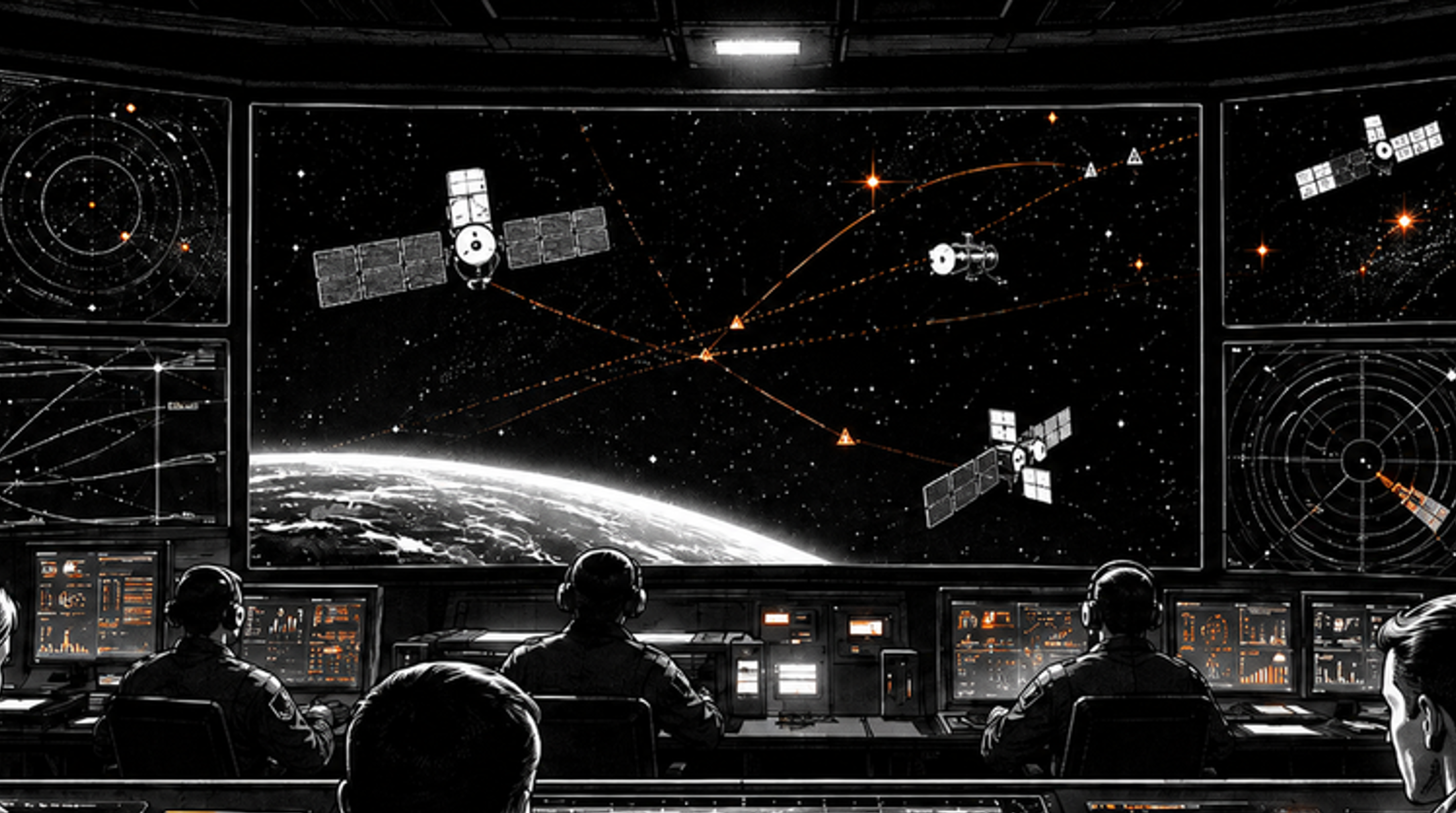
The weaponization of space is no longer theoretical; it has become active strategic priorities that are shaping the future of conflict. Space has transformed into a contested domain where satellites and orbital infrastructure are not only operational assets but also potential targets, making their control central to modern military strategy. Systems originally designed for civil or defensive purposes can now be repurposed for offensive operations, blurring the lines between civilian and military applications and complicating international regulations.
The reliance on commercial satellite constellations has further highlighted the strategic importance of civilian infrastructure: during the Russo-Ukrainian conflict, Starlink satellites proved essential for battlefield communications and coordination, showing how such networks can become critical military enablers or points of vulnerability.
In response to these evolving threats, programs like France’s annual AsterX exercise have emerged to test operational readiness against orbital interference, cyberattacks, and satellite maneuvering scenarios, emphasizing the importance of training, rapid decision-making, and coordination. The technological complexity of space weaponization, from ASAT missiles to directed-energy weapons, electronic warfare, and cyber-enabled capabilities, drives both innovation and high costs, restricting advanced development to a few highly capable actors.

Context
Weaponization of space refers to the development or deployment of systems capable of threatening, neutralizing, or destroying space assets. Unlike militarization, which uses space for communication, navigation, or observation, weaponization transforms space into an offensive domain. This includes anti-satellite missiles, electronic jammers, cyber capabilities, and directed-energy weapons, as well as terrestrial systems designed to strike targets in orbit.
Historically, the Cold War spurred experimental space weapons programs in the United States and the Soviet Union, laying conceptual foundations without establishing permanent orbital arsenals. In 2007, China’s destruction of its Fengyun‑1C satellite with a direct‑ascent missile produced thousands of debris fragments, signaling the risks of active weapons in orbit.
The 1967 Outer Space Treaty bans weapons of mass destruction in orbit but leaves conventional offensive capabilities largely unregulated. This legal gap has allowed states to develop anti-satellite systems, dual-use technologies, and other offensive tools without formally violating international law. Civil or defensive satellites, for example, could be repurposed to interfere with adversary spacecraft.
Recent years illustrate escalating activity: India tested an ASAT in 2019, Russia destroyed Kosmos‑1408 in 2021, and reports suggest Russia may be developing weapons targeting large constellations like Starlink.
Satellites increasingly perform coordinated “dogfighting” maneuvers or shadow high-value assets, reflecting rising competition and the potential for conflict in orbit.
Space is no longer just a support domain, it is now a strategic environment where offensive capabilities, legal uncertainty, and dual-use technologies converge, raising global security stakes.
1 . Market Overview
1.1. Market size, growth dynamics and key figures
Estimating the current size of the anti-satellite (ASAT) and space weaponization market is extremely challenging. Most programs are classified, with budgets, timelines and procurement plans largely undisclosed. While precise figures are unavailable, clear trends indicate growing investment in space-based offensive and defense capabilities.
Three key factors are driving this growth:
- Geopolitical competition: Rising tensions among major spacefaring powers primarily the US, China, and Russia are spurring the development of systems capable of disrupting or destroying adversary satellites. China’s DN-3 missile and co-orbital systems, as well as Russia’s 2021 destructive ASAT test on Kosmos‑1408, exemplify the perceived threats motivating accelerated spending on counterspace programs.
- Strategic value of satellites: Military reliance on satellites for communications, navigation, ISR, and missile warning makes them high-value targets. The 2024 Russian electronic warfare actions against Ukrainian satellite links illustrate how terrestrial conflicts can expose space vulnerabilities, heightening the imperative to defend and contest space assets.
- Technological advances: Direct-ascent interceptors, directed-energy weapons, electronic warfare, and cyber-enabled ASAT systems are enabling more precise, flexible, and debris-conscious counterspace operations, especially against growing low Earth orbit constellations.
Together, these trends point to a fast-growing, high priority domain, positioning ASAT capabilities as a central component of modern space defense strategy.
1.2. Key Challenges
We have identified 5 majors challenges:
- Legal & regulatory ambiguity
The 1967 Outer Space Treaty bans weapons of mass destruction in orbit but does not explicitly prohibit conventional ASATs, co-orbital systems, or non-kinetic capabilities. This gap allows offensive programs while creating uncertainty and risks of misinterpretation or escalation.
- Risk of space debris
Kinetic ASAT tests, like China’s 2007 Fengyun‑1C and Russia’s 2021 Kosmos‑1408 strikes, generate thousands of high-speed fragments that endanger all satellites and human spaceflight. Even non-kinetic attacks can cause operational hazards, pushing states toward “gray zone” methods such as jamming, blinding lasers, and cyber operations to avoid widespread debris
- Technical complexity & high costs
Intercepting satellites moving at kilometers per second demands extreme precision, advanced sensors, guidance, and real-time orbital tracking. Non-kinetic systems, directed-energy weapons, electronic warfare, cyber ASATs, require cutting-edge technology and integration across ground, air, and space platforms. Testing is costly and risky, limiting these capabilities to highly advanced nations
- Escalation and deterrence dynamics
Even defensive measures can be perceived as offensive, creating a classic security dilemma. Satellite manoeuvres, hardening, or non-destructive counter-space operations may trigger rival programs or rapid responses, fueling an orbital arms race.
- Operational vulnerability
Satellites are fragile and highly exposed. Minor miscalculations can disable friendly assets or produce debris, while reliance on ground stations and communication links adds further vulnerability, increasing operational risk and cost.

1.3 Current momentum and why it matters now
In recent years, space has shifted from a strategic concept to a contested operational domain. The Russo‑Ukrainian war demonstrated this concretely: Starlink, the SpaceX satellite constellation, became a critical communications backbone for Ukraine, highlighting how disruption of space assets directly affects terrestrial operations.
This reality has accelerated the development of French counter-space capabilities. Key programs include: YODA, a geostationary satellite demonstrator (managed by Hemeria) that will test manoeuvres and operations in orbit; TOUTATIS, a pair of nanosatellites developed by U-Space for “cat-and-mouse” orbital exercises simulating real conflict scenarios; Bloomlase and FLAMHE, ground-based high-energy laser tests aimed at blinding or neutralizing satellites; Delf.SSA, which uses AI developed by Delfox alongside ArianeGroup and Exotrail’s telescope network to enhance orbital traffic monitoring.
At the EU level, the EU Space Strategy for Security and Defence aims to strengthen resilience, space domain awareness, and dual‑use capabilities (including pilots for space domain awareness services and enhanced Copernicus observation) to protect European assets and deter hostile activities.
In Europe, collaborative projects like EMISSARY (European Military Integrated Space Situational Awareness and Recognition Capability) are being launched to build interoperable space surveillance capabilities, a foundational element for defensive and counter‑space operations.

Across the Atlantic, the U.S. Space Force has operationalized new paradigms such as Tactically Responsive Space (TacRS), exemplified by missions like VICTUS NOX, which demonstrated the ability to rapidly build, launch, and operate satellites in response to threats. Future TacRS missions, including Victus Haze, Victus Surgo, and Victus Salo, are designed to shorten launch timelines and experiment with on‑orbit manoeuvring and space domain awareness, leveraging commercial partners to enhance agility and responsiveness.
Additionally, exercises like Hack‑A‑Sat engage the security research community to identify vulnerabilities and harden space systems against cyber and signal threats, emphasizing resilience alongside offensive/defensive development.
These programs show that space is increasingly treated as a contested domain for defence, resilience, and strategic control, not just reconnaissance or communication, reflecting a broader shift toward operationalised space security capabilities.
1.4 Core use cases and applications
The weaponization of space is no longer a theoretical concept, it is becoming a practical dimension of modern military strategy. States are increasingly developing and testing technologies that can disrupt, neutralize, or manipulate satellites, and these capabilities are already being applied in real-world situations. The core use cases of space weaponization reflect the dual need to project power and protect critical space assets.
One of the most direct applications is the ability to temporarily or permanently disable enemy satellites. Kinetic attacks via ASAT missiles, non-kinetic measures such as directed-energy weapons, electronic jamming, and spoofing GPS signals are all used to interrupt adversary capabilities. In a conflict, neutralizing communication or navigation satellites could paralyze enemy command, control, and logistics, giving a decisive operational advantage without engaging terrestrial forces directly.
Possessing offensive space capabilities also serves as a deterrent and a means of strategic signaling. Nations that demonstrate the ability to deny orbital access or interfere with satellites signal to potential adversaries that aggressive actions could be met with consequences in space. Co-orbital satellites, electronic warfare systems, and other counter-space tools allow states to project power and protect their assets while minimizing escalation. This strategic signaling mirrors classical deterrence concepts, reinforcing stability while asserting capability.
Weaponization also encompasses the protection and resilience of one’s own space assets. Maneuverable satellites, early-warning sensors, counter-jamming systems, and robust cybersecurity for ground stations are all essential to safeguard critical infrastructure. Co-orbital platforms or satellites capable of rapid repositioning can evade interference or collisions, ensuring continuity for communication, navigation, and ISR operations. These defensive applications illustrate that weaponization is not solely about offense; maintaining the operability of a nation’s own satellites is a core strategic priority.
Maintaining situational awareness in orbit is another central application. Co-orbital satellites and Space Situational Awareness (SSA) systems allow states to track adversary satellites, analyze orbital behavior, and identify vulnerabilities. Satellites performing rendezvous and proximity operations (RPO) provide critical intelligence about adversary activities, enabling planners to anticipate threats, protect their assets, and, if necessary, prepare offensive actions. Control of the orbital environment is thus both a defensive and offensive enabler.
Many operations today take place in the “gray zone”, where satellites are disrupted or degraded without being destroyed, reducing debris and escalation risks. The interference with Starlink satellites in Ukraine is a clear example, showing how temporary disruption can affect communications without generating long-term hazards in orbit. Programs like TOUTATIS further demonstrate how controlled interference can be used strategically, allowing nations to exert influence in space while keeping operations reversible and measured.
Finally, space weaponization has important implications for terrestrial military campaigns and strategic operations. By controlling or contesting space-based assets, military planners can enhance the effectiveness of ground, air, and naval operations, deny the same advantages to adversaries, and create asymmetrical effects. Satellites providing ISR or early missile warning can be targeted or degraded to shape the operational environment, giving decision-makers new tools to influence conflicts from orbit.
2. Warfighting capabilities and key players
We analyzed 5 key capabilities for space weaponization:
- Kinetic Anti-Satellite weapons
They are designed to physically intercept and neutralize satellites or other space infrastructure. They can be launched from the ground, air, or sea and come in two main forms: direct-ascent missiles, which follow a straightforward trajectory toward a target, and co-orbital systems, where a satellite is placed in orbit and later approaches the target satellite to disable or destroy it. These systems require extremely precise sensors and guidance systems capable of tracking and intercepting objects moving at several kilometers per second in orbit, as well as advanced propulsion to reach the required altitude and trajectory. Tests conducted by China on Fengyun-1C in 2007 and by Russia on Kosmos-1408 in 2021 demonstrate both the effectiveness of these weapons and the dangers of creating long-lasting orbital debris. Due to their high complexity and cost, ASAT systems remain primarily the domain of states and large defense contractors rather than startups. Currently there are no missiles placed in space
- Directed energy weapons
They use high-powered lasers or microwaves to render a satellite inoperative or degrade its capabilities without physical contact. These systems can dazzle optical sensors, overheat electronic components, or disrupt critical satellite functions, offering a non-kinetic approach to weaponization. Developing DEW technologies requires powerful energy sources, adaptive optical systems, and precise targeting to affect a satellite hundreds of kilometers above Earth. One of the main advantages of DEWs is that they can neutralize satellites without generating debris, making them particularly suitable for operations in the “gray zone”. While no startup currently advertis es a dedicated offensive laser weapon in orbit, several companies are developing space‑qualified laser technologies that illustrate how commercial innovation is progressing in related optical and laser domains. Orbital Lasers, spun out from the Japanese operator SKY Perfect JSAT, is developing compact, high‑efficiency laser systems for space debris removal and satellite LiDAR services, supported by collaborations with RIKEN and funding from programs like Japan’s J‑Startup initiative.
The company’s efforts aim to enable world‑first satellite laser applications that could, in future, support non‑destructive counterspace and debris mitigation missions rather than offensive attacks. Another example of laser technology in space is Mynaric, a German‑US company specializing in laser communication terminals for high‑bandwidth links between satellites and ground stations. Although its lasers are designed for data transmission rather than weaponization, the underlying optical technology illustrates how laser systems are being qualified for flight and may provide a foundation for future directed energy capabilities.
Transcelestial focus on optical inter‑satellite communication using laser links to enable secure, high‑speed data transfer in orbit. These platforms are not weapons but demonstrate the broader trend of laser systems becoming operational in space, including potential dual‑use applications in defense or counter‑space strategies as technologies mature.

Another example is Odysseus Space that for instance, is working with EDF on the E-Oblinding 2026 project, which aims to develop satellite-blinding resilience and directed-energy techniques to counteract optical interference and ensure satellite operational security.
Orbital Lasers, spun out from the Japanese operator SKY Perfect JSAT, is developing compact, high-efficiency laser systems for space debris removal and satellite LiDAR services, supported by collaborations with RIKEN and funding from programs like Japan’s J Startup initiative. The company’s efforts aim to enable world-first satellite laser applications that could, in future, support non-destructive counterspace and debris mitigation missions rather than offensive attacks.
- Electronic warfare
Electronic warfare in space includes jamming and spoofing. Jamming involves overloading a satellite’s communication frequencies to interrupt uplink or downlink signals, while spoofing mimics legitimate signals to deceive a system, for example by providing false positioning data or taking apparent control of a command link. These technologies rely on powerful, targeted RF emissions and adaptive spectrum management to bypass satellite protections. A concrete example of a company working in this domain is Slingshot Aerospace, which develops tools to detect and analyze GPS jamming and spoofing in space environments. Their systems, supported by contracts with the U.S. Space Force, use AI and predictive modeling to monitor constellations for abnormal signal behavior, providing early warning and situational awareness against potential electronic interference. While these technologies are defensive in nature, they illustrate how startups are contributing to the practical implementation of electronic warfare concepts in orbit.

- Cyber operations
Targeting space can focus either on satellites themselves (by taking control, corrupting data, or disrupting operations) or on ground control infrastructure, including command stations and networks that manage satellite fleets. These attacks rely on exploiting vulnerabilities in software, communication protocols, and onboard systems, often using custom malware or advanced intrusion techniques. This is where SpiderOak becomes particularly relevant. SpiderOak is a U.S.-based startup specializing in cybersecurity for space infrastructure, focusing on the protection of satellites, ground control networks, and command-and-control systems. Its solutions are designed to prevent unauthorized access, maintain secure communications, and safeguard operational continuity through zero-trust architectures, micro-segmentation, and end-to-end encryption. Even without developing kinetic, directed energy, or electronic warfare capabilities, SpiderOak contributes directly to the space defense ecosystem by strengthening the resilience of orbital assets against cyber intrusion, data compromise, and loss of operational control.

- Proximity operations and co-orbital satellites
Involve spacecraft designed to approach other satellites, either for inspection, maintenance, or, in a defensive or offensive context, for neutralization. These technologies require highly precise propulsion, autonomous navigation, and sophisticated guidance software, as well as sensors capable of determining the position and orientation of nearby objects. In some cases, co-orbital systems can make physical contact with a target satellite to reposition it into a different orbit, demonstrating that weaponization extends beyond direct strikes: the ability to maneuver around, interact with, and even relocate other satellites in orbit is already an operational capability shaping contemporary space strategy. This is the area where the startup ecosystem is the most visible. True Anomaly, Shield Space × EnduroSat, and Dark all illustrate how commercial actors can contribute to autonomous space defense and counter-space capabilities through maneuverable platforms, rendezvous and proximity operations, and real-time orbital decision-making tools.

True Anomaly is a U.S based startup at the forefront of autonomous space operations and space defense technologies. The company develops autonomous orbital vehicles capable of performing rendezvous and proximity operations, allowing satellites to approach, inspect, or interact with other spacecraft in orbit. These capabilities are critical for defensive missions, such as protecting high-value assets, but may also support offensive or gray-zone operations such as monitoring or temporarily neutralizing adversary satellites without direct kinetic engagement. In addition to hardware, True Anomaly provides command, control, and analytics software through its Mosaic platform, which fuses orbital data in real time to support space situational awareness, behavior analysis, and autonomous maneuver planning. The startup has established public PoCs and contracts with the U.S. Space Force, including SBIR funding for space domain awareness (SDA) and participation in Tactically Responsive Space missions such as the Victus series, which test rendezvous and proximity operations in orbit.

Shield Space, in partnership with EnduroSat, represents a European approach to agile counter-space and autonomous orbital platforms. The collaboration aims to develop satellites capable of rapid maneuvering, proximity operations, and orbital threat response. Their BROADSWORD demonstrator combines EnduroSat’s flexible small satellite buses with Shield Space’s mission planning and control expertise, enabling rapid deployment and operational testing of modular counter-space technologies. These platforms are designed for inspection, monitoring, threat response, and controlled interference missions, providing defensive and gray-zone capabilities without generating debris.
Dark was a French startup focused on tactical orbital platforms for satellite neutralization and controlled intervention in space. The company explored vehicles capable of approaching, maneuvering around, and potentially neutralizing satellites, with applications ranging from defensive protection of national constellations to gray-zone operations. Although Dark has ceased operations, its work remains relevant as an early example of startup-driven innovation in maneuverable platforms, air-launched orbital interceptors, and counter-space concepts.
Starfish Space is a U.S.-based company developing robotic satellite servicing and maneuvering technologies, including platforms capable of docking, repositioning, and performing in-orbit repairs. While primarily designed for satellite maintenance and life-extension, these technologies also demonstrate the potential for controlled manipulation of other spacecraft, making Starfish a key actor in the broader autonomous orbital operations ecosystem. The startup has multiple Space Force contracts, including APFIT and STRATFI awards, to develop its Otter vehicles for autonomous servicing, docking, on-orbit support, and satellite de-orbit capabilities.
Katalyst Space Technology is an emerging U.S. startup focused on highly agile satellites capable of on-orbit servicing, repositioning, and inspection. Their work on modular robotic arms and autonomous navigation enables precise interaction with other satellites, supporting both commercial servicing missions and potential defensive or gray-zone applications in space.
Overall, the startup ecosystem does not yet appear to include many companies specialized in fully-fledged counter-space weaponization technologies such as kinetic ASAT systems, directed energy weapons, or dedicated electronic warfare capabilities. These domains remain largely controlled by state actors and major defense contractors due to their technical complexity, cost, regulatory sensitivity, and strategic implications. However, many startups are emerging around adjacent and enabling capabilities, especially space surveillance, space situational awareness, orbital protection, cyber resilience, autonomous maneuvering, and proximity operations. These technologies contribute indirectly to the counter-space ecosystem by helping operators detect threats, protect high-value assets, and maintain control in contested orbital environments. In parallel, some defense startups are also developing advanced missile technologies, including hypersonic systems, which could become relevant to the broader counter-space and strategic strike landscape, even if they are not purely space-focused today.
Conclusion
The weaponization of space has moved from theoretical discussion to a tangible reality, reflecting both the growing strategic importance of orbital assets and the vulnerabilities inherent in modern military operations. Across kinetic ASAT systems, directed-energy weapons, electronic warfare, cyber capabilities, and autonomous orbital platforms, nations and commercial actors are rapidly developing technologies that can disrupt, neutralize, or protect satellites.
The emergence of startups such as True Anomaly, Shield Space × EnduroSat, Portal Space Systems, and SpiderOak illustrates that innovation is no longer solely in the hands of state actors, and that agility, modularity, and rapid deployment are becoming key enablers of modern space defense.
In this evolving landscape, the core challenge for policymakers, militaries, and commercial operators will be to balance technological advancement with operational safety, regulatory clarity, and international norms, ensuring that space remains a domain where strategic advantage can be pursued without triggering uncontrollable escalation or debris proliferation. The future of space weaponization will not only define military capabilities in orbit but also shape the broader geopolitical order, technological innovation, and resilience of critical infrastructure on Earth and in space.