Defending the Skies
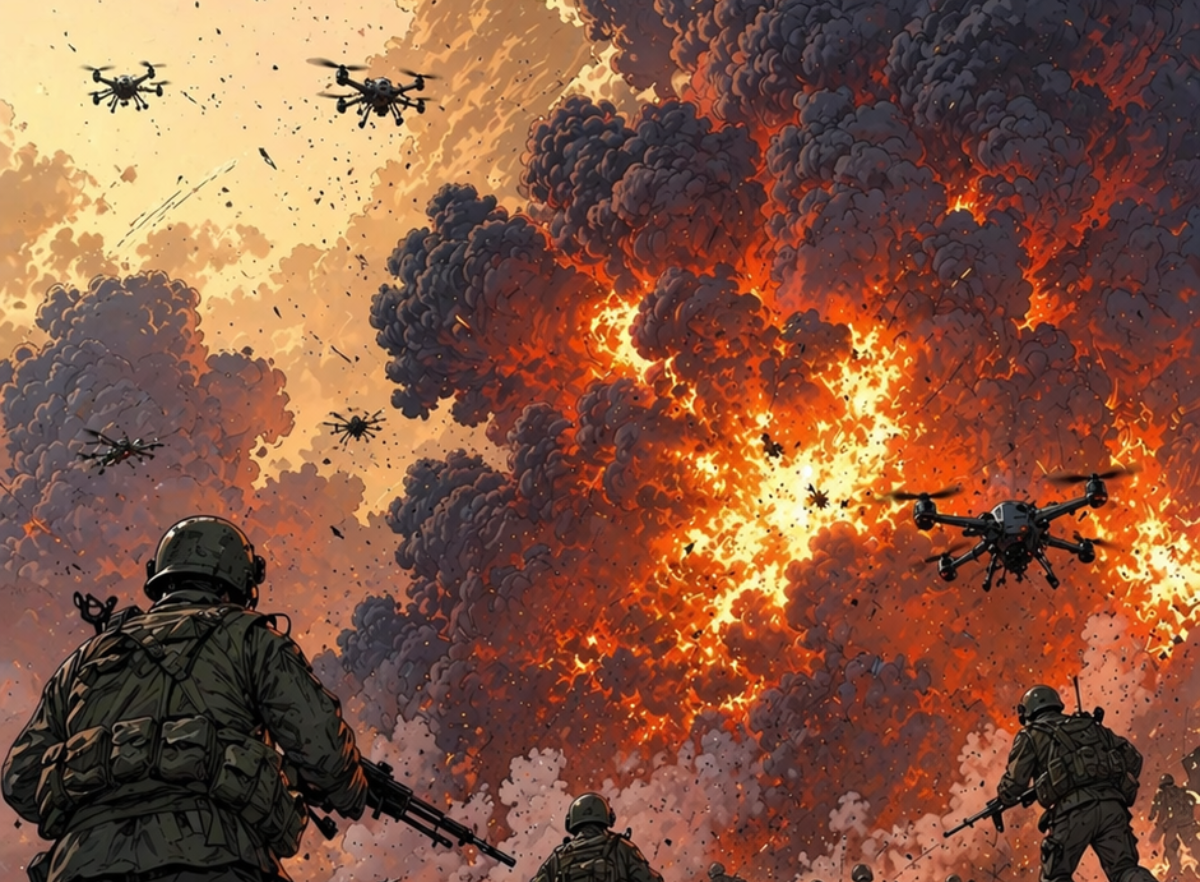
The defence sector is entering a new era, driven by conflicts that are reshaping the rules of the game.
In this white paper series, you will find the insights needed to stay up to date with the latest market trends and disruptive technologies. Each month, our experts analyse key developments across the ecosystem, combining market data, field insights and strategic perspectives.
Constantly engaged with institutional players, industrial leaders and startups, Starburst provides a unique perspective on how defence markets are evolving and where the next opportunities lie.
Context
The global military landscape is undergoing a profound transformation, largely driven by the rise of drones. Conflicts such as the war in Ukraine have underscored the pivotal role drones now play on the battlefield, with up to 70% of military losses attributed to these devices. Traditionally seen as tools for surveillance or reconnaissance, drones have now evolved into full-fledged weapons of warfare, redefining the rules of military engagement. The threats posed by drones are diverse, ranging from small commercial drones modified into precision weapons, to more sophisticated systems used for long-range targeted strikes.
In light of this rapid proliferation, counter-unmanned aerial systems (CUAS) have become a key strategic focus for both military and industrial actors. Based on our analysis, the CUAS market is forecasted to grow at a 16% compound annual growth rate (CAGR), increasing from €2.6 billion in 2024 to €5.5 billion in 2029.
The US currently dominates the market, holding over 60% of the market share, with a total value of €9.4 billion expected from 2024 to 2029. However, despite advancements in anti-drone technologies, many solutions face technical and economic limitations, as the nature of the drone threat continues to evolve.
In this article, we will delve into the critical issues surrounding drone threats and current counter-drone solutions, exploring the following key topics:
- Drones are redefining the battlefield: How the drone threat is reshaping modern warfare strategies, highlighting their growing role in current conflict zones and their impact on traditional combat methods.
- Why drones are difficult to counter: The key reasons why drones are particularly challenging to intercept, including their small size, low signature, and ability to operate autonomously and discreetly.
- Understanding drone types and battlefield uses: A classification of the different types of drones used on the battlefield, focusing on their distinctive characteristics that make them difficult to neutralize.
- Mapping the counter-drone kill chain: An overview of the various stages in the counter-drone process, from detection and identification to neutralization, covering the technologies used at each stage.
- The next frontier of counter-drone warfare: The remaining technological hurdles in countering drones, such as detecting small drones, ensuring system effectiveness in complex urban environments, and managing autonomous drones.
- A landscape structuring around operational reality: An analysis of the industrial players in the anti-drone space, highlighting key actors in different regions and sectors such as detection, identification, and neutralization technologies.
This article aims to provide a comprehensive understanding of the current dynamics and the challenges ahead in addressing the growing drone threat in an increasingly contested environment.
1.2 Drones are redefining the battlefield
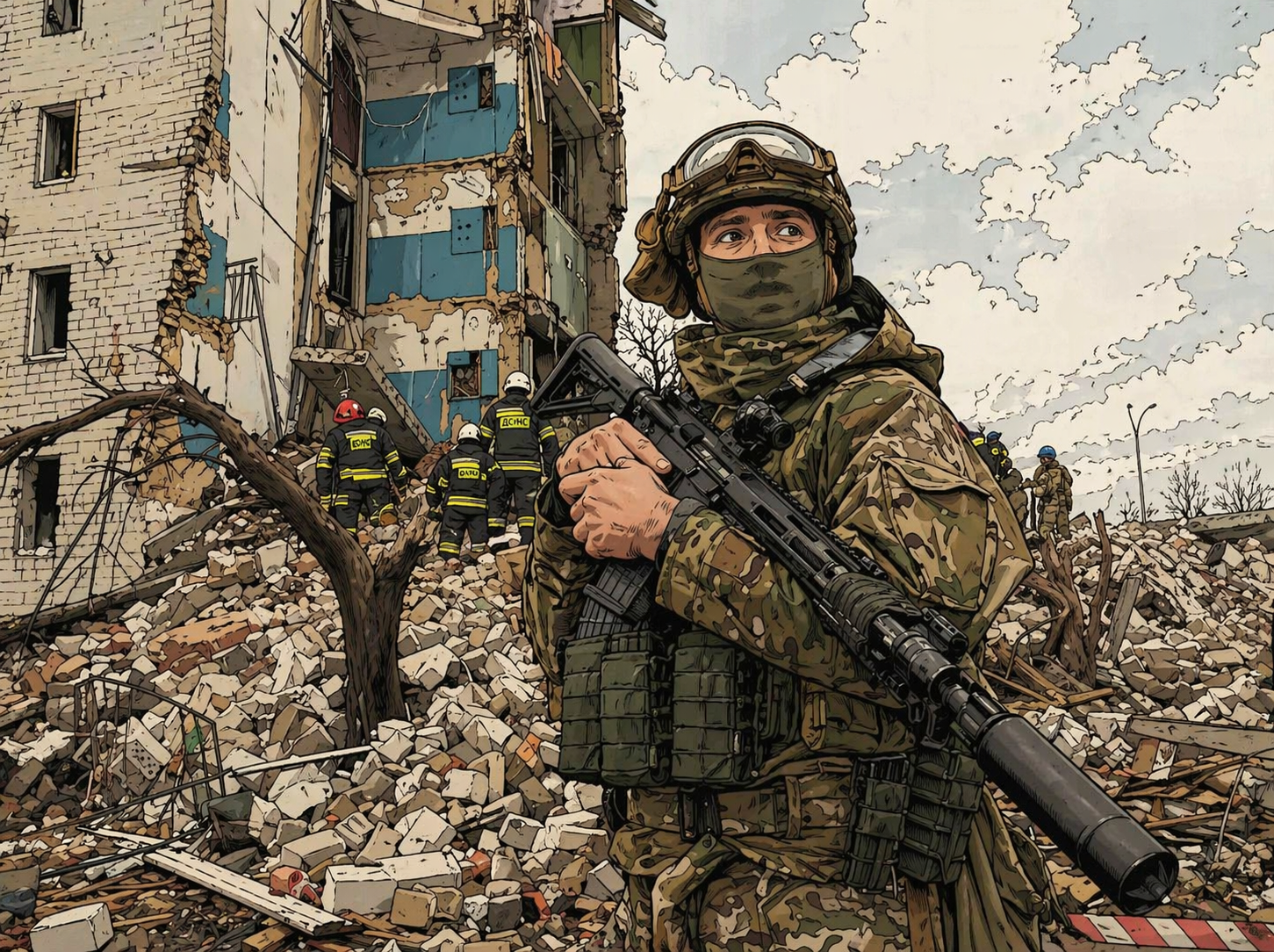
Warfare is undergoing a dramatic shift, moving away from traditional platform-centric approaches, where tanks, aircraft, and large-scale military assets dominated the battlefield, towards a more distributed, drone-enabled attrition model.
The emergence of drones as primary weapons of war has fundamentally changed how conflicts are fought, with smaller, low-cost drones now capable of inflicting significant damage.
Another stark example of this shift is the remarkable cost-exchange ratio that has turned the battlefield dynamics upside down.
“Drone warfare is reshaping defense, requiring integrated, scalable, and multi-layered solutions” Clémence Carle, Starburst
For instance, a First-Person View (FPV) drone costing as little as €500 – 5,000 can destroy a tank worth several million euros. This cost-effectiveness has fueled the mass industrialization of drones, particularly in Ukraine, where over 4 million drones have been produced in 2025 alone, highlighting the potential for low-cost, high-impact warfare.
The battlefield is also increasingly absorbing civilian technology, with commercial drones rapidly being weaponized at scale. In Ukraine, civilian-grade drones have been adapted for reconnaissance and precision strikes, contributing to an exponential increase in the number of drone-based attacks.
Moreover, the electronic warfare (EW) advantage previously held by traditional military powers is beginning to erode. Drones equipped with autonomous navigation and GNSS-denied capabilities are challenging the effectiveness of traditional countermeasures, forcing military forces to adapt quickly.
While these new drone technologies pose significant challenges, they also demonstrate a shift towards swarm-like tactics, where scale rather than sophistication is becoming the primary factor. The massive deployment of drones in swarming configurations has made it clear that the future of warfare may no longer depend on individual capabilities but on overwhelming numbers and the ability to saturate defenses.

2. Why are drones difficult to counter?
The proliferation of drones, especially in military and civilian contexts, has introduced a set of complex challenges that defense systems around the world must contend with.
Drones, whether employed for surveillance, cargo delivery, or as loitering munition, pose a growing and diverse threat to both strategic military assets and critical infrastructure.
While numerous counter-drone technologies have been developed, they struggle to effectively address the nuances of this rapidly evolving threat landscape. Below are key challenges contributing to the difficulty in countering drones:
Saturation and mass deployment
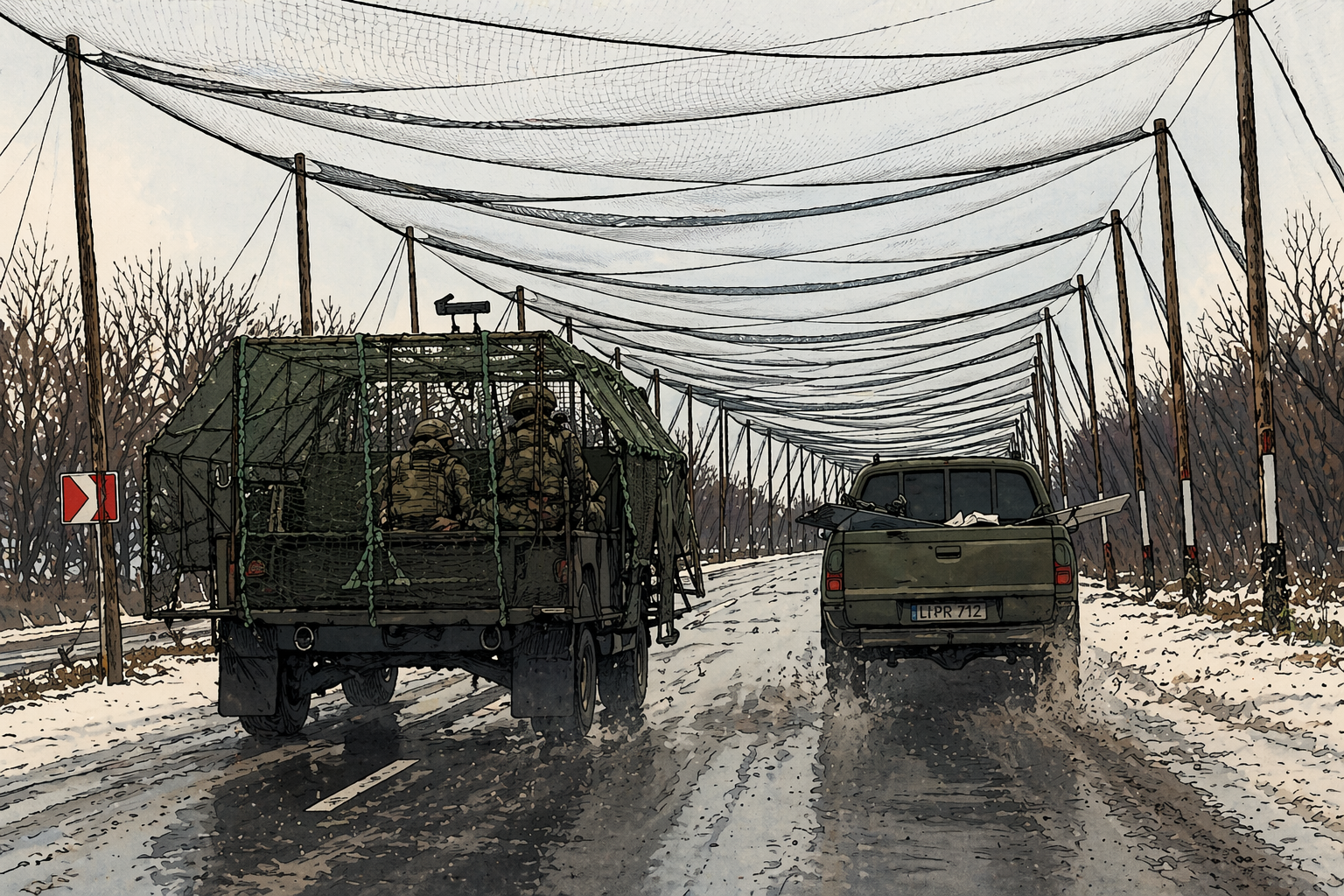
Drones offer significant cost-effectiveness and scalability. For example, the Shahed-136 drone costs around $20,000–$50,000 per unit, enabling adversaries to deploy hundreds or thousands in a single operation, overwhelming air defense systems. In 2026, Russia launched over 6,400 Shahed drones in one month in Ukraine, averaging 208 drones per day. These low-cost swarms force defenders to use expensive countermeasures, creating a cost-exchange imbalance. The 2026 Gulf conflict saw 2,000 drones launched against the UAE, demonstrating how mass deployment outpaces traditional defense capabilities
Autonomous navigation and inertial guidance
Drones with autonomous navigation reduce reliance on real‑time control and can complete missions even under GNSS disruption, complicating interception.
Many incorporate inertial navigation and sensor fusion to maintain course when GPS is jammed, shrinking the window for defenders to react. The widely exported Bayraktar TB2, with >800 built and 1 million+ flight hours globally, can autonomously taxi, take off, cruise, and land using internal sensors when GNSS is degraded, increasing its resilience to jamming and making interception harder. Its long endurance (20+ hours) and ability to fly beyond line‑of‑sight mean that defenders must detect and engage it early in its flight path to be effective.
Low-altitude flight
Many modern attack drones are designed with small radar cross‑sections and to fly very low to the ground, making them hard for traditional air defense radars , tuned for faster, higher targets, to detect reliably. For example, the Shahed‑136’s delta‑wing design produces a radar return as low as 0.01–0.1 m², comparable to a small bird rather than a jet, and it typically cruises at 50–300 m altitude, where ground clutter from buildings and vegetation further masks its signature.
This combination compresses detection timelines and forces defenders to spot and track targets late, reducing reaction windows and increasing interception difficulty. In the 2022 Ukrainian campaign, Shahed drones repeatedly penetrated air defenses by exploiting low‑altitude corridors; in one documented wave, 24 such UAVs were launched against Odesa, with only roughly half intercepted.
Quantitatively, their low flight profile means many ground‑based radars struggle to differentiate drone echoes from environmental noise, requiring advanced sensor fusion (radar + optical/IR) and AI classification to avoid false negatives, a capability many legacy systems lack.

Lack of standardization in countermeasures
Despite a growing market of counter‑UAS solutions, from electronic warfare jammers and radar sensor suites to kinetic interceptors and autonomous interceptor drones, there is no universally accepted standard for how these systems communicate, share data, or interoperate.
This fragmentation means operators often deploy multiple, incompatible systems that cannot easily fuse detection, tracking, and engagement data in real time, creating blind spots in defense coverage.
For example, in the Ukraine conflict, defenders employ a patchwork of systems, from NATO‑supplied air defenses and Western EW gear to Ukrainian low‑cost acoustic detectors and 10,000+/month small interceptor drones like the $2,100 ‘Sting’, but integration remains ad hoc, limiting effectiveness.
Quantitatively, initiatives to harmonize standards are only just emerging: the US‑UK Joint Declaration on common counter‑drone data standards aims to align C‑UAS data formats across up to 25 allied nations by summer 2026 to improve sensor fusion and response times. Without such standards, disparate detection formats and proprietary protocols continue to slow cross‑platform tracking and joint engagements.
Legal and ethical considerations
The widespread use of drones, especially civilian drones, creates complex legal and ethical challenges for counter‑UAS responses. Military drones generally operate under clear rules of engagement, but unauthorized drones in civilian airspace do not, making enforcement actions like jamming or shooting down devices legally fraught. Countermeasures such as RF jamming can inadvertently disrupt GNSS, Wi‑Fi, or aviation communications, raising liability and safety concerns in populated areas. This forces authorities to balance security imperatives with civil liberties, privacy, and aviation safety regulations.
Quantitatively, drone‑related airport disruptions in Europe have surged: reports at more than 24 airports in 12 countries show incident frequency quadrupled between January 2024 and November 2025, with countries like Belgium logging 10 drone‑related disturbances in just eight days in early November 2025.
At Munich Airport, multiple drone sightings on 2–3 October 2025 forced runway closures that canceled 17 flights and affected ~3,000 passengers, and a second interruption within 24 hours disrupted an additional 6,500 passengers. Due to safety and legal limits, authorities refused to shoot down drones, underscoring the difficulty of responding when the identity and intent of operators are unknown. The absence of EU‑wide operational standards for counter‑UAS rules of engagement further complicates rapid, coordinated responses, prompting regulators like EASA and the European Commission to develop guidance and an EU Action Plan to harmonise detection, response protocols, and civil‑military cooperation.

3. Understanding drone types and battlefield uses
The NATO classification system provides a valuable framework to segment drone threats by size and operational capability. It categorizes drones into three main classes: Class 1 (Micro, Mini, Small), Class 2 (Small-Medium), and Class 3 (Large). This classification allows for a clearer understanding of the different roles’ drones play in modern warfare and their corresponding operational challenges.

However, recent conflicts, most notably in Ukraine, have demonstrated that while this framework remains relevant, the effectiveness of counter-drone solutions varies significantly across categories and is evolving rapidly. Electronic warfare, for instance, has long been considered a cornerstone of counter-drone strategies. Startups such as Soraccel are developing advanced jamming solutions designed to disrupt drone communications and navigation. Yet, the battlefield reality shows increasing limitations: many modern drones are now equipped with anti-jamming capabilities, including frequency hopping, multi-antenna systems, and autonomous navigation modes.
As a result, jamming alone is no longer sufficient and must be integrated into a broader, multi-layered defense approach.
At the same time, kinetic interception systems such as missiles remain essential, particularly against larger and more sophisticated threats. However, their use is increasingly challenged by cost asymmetry. The widespread deployment of low-cost loitering munitions such as the Iranian Shahed-136, extensively used in Ukraine, illustrates this shift. These drones can be produced and deployed at scale for a fraction of the cost of the missiles used to intercept them, creating an economically unsustainable defense model. This has forced armed forces to rethink their reliance on traditional high-cost interception systems.
Finally, directed energy solutions are often presented as a breakthrough in counter-drone capabilities. However, it is important to distinguish between the different types of laser-based technologies currently under development. Startups such as Iris Lab is pioneering low-cost, mass-deployed anti-drone laser systems designed to combat the growing drone threat. Unlike traditional high-power laser systems, which are expensive and maintenance-heavy, Iris Lab focuses on providing a cost-effective solution by using laser technology tailored to counter small drones like FPVs (First-Person View drones).
Their system operates with a much smaller power output (5kW vs. the typical 100kW used in military-grade systems), making it more affordable and scalable. Their approach includes mobile anti-FPV laser units priced at €200K, which is ten times less than legacy systems. These units offer ultra-precise optical tracking, with a range of 500 meters, and are designed for rapid deployment in critical areas. The company aims to disrupt the market by addressing swarms of drones in an efficient and practical manner, reducing the cost-per-shot.
4. Mapping the counter-drone kill chain
The counter-drone kill chain consists of three key stages: Collect, Analyse, and Neutralize. At each stage, different technologies are employed to detect, track, and neutralize drone threats, with each stage playing a critical role in the success of C-UAS operations. Below is a detailed breakdown of the key technologies used in each stage.

Various sensor technologies are used to collect data and identify potential threats:
- Radar: Widely used in the detection phase to locate drones by bouncing radio waves off objects in the air and measuring the reflected signals. Startups like Robin Radar have developed specialized drone detection radars optimized for tracking small, low-flying UAVs in challenging environments. In the case of drones, radar systems need to detect small, low-flying objects, which is more challenging than tracking traditional aircraft. These radars often work in different frequency bands (e.g., S-band, X-band) to optimize detection based on the drone’s size and altitude
- Passive radar: Do not emit their own signals; instead, they capture the electromagnetic waves that are reflected off objects in the air from existing broadcast signals (e.g., TV or radio transmissions). This makes passive radar less detectable by drones, offering a stealthy detection method. Startup like XADITE have developed advanced passive radar systems that utilize signals of opportunity to detect and track drones in a non-intrusive and covert manner. While effective in urban environments where other radar systems may struggle, passive radar is limited by the availability of strong external signals
- Optical sensors & Acoustic sensors: Optical sensors, such as EO/IR cameras, can be used to visually track and identify drones. Acoustic sensors, on the other hand, capture the sound produced by drones to help locate them. A good example of it is BeephoniX, whose M2 acoustic detection system uses a dense array of microphones and AI-driven signal classification to detect and track small drone threats even in complex electromagnetic environments
- EO/IR: Use visible light (EO) and infrared radiation (IR) to detect drones. These systems can spot drones both during the day and at night by detecting their heat signatures or visual characteristics. Startups such as Walaris with its AirScout product develop multispectral EO/IR imaging solutions that leverage computer vision and edge-optimized AI to detect, acquire, classify, and track small unmanned aerial systems across diverse environments. EO/IR is especially effective in providing visual identification and tracking, and it can be used to spot drones that do not emit RF signals
- RF sensing: Detect the radio frequencies used by drones for communication and control. These sensors can capture the signals transmitted between a drone and its operator or its control station. Startups like Hidden Level, which develops advanced passive RF sensing solutions to detect and track drones via their RF emissions, provide mission-ready RF awareness that enhances situational awareness in complex environments. Similarly, Dedrone’s RF-based sensors (e.g., DedroneSensors) can detect, classify, and even localize drones and their pilots by analyzing communication signals, giving security operators real-time insights. RF sensing is especially effective for detecting drones that rely on RF for guidance. This type of detection can track the drone’s location based on the strength and direction of the RF signals and feed into larger counter-UAS ecosystems
2. Identify/Analyse
Once a drone is detected, the next step is identifying its type and determining its threat level.
Various technologies support this process:
- Sensor fusion: Combines data from multiple detection systems (e.g., radar, RF sensors, EO/IR) to create a more comprehensive picture of the drone threat. By integrating data from different sources, sensor fusion improves detection accuracy and helps track the drone in challenging environments. Startups like Picrogrid are advancing sensor fusion by developing innovative platforms that integrate various sensor types to improve drone detection and tracking. Picrogrid’s solution enhances situational awareness by merging data from radar, RF, and optical sensors, providing a more accurate and holistic understanding of the drone threat landscape. This approach enables more precise tracking in environments where traditional detection methods might struggle, showcasing the value of sensor fusion in layered CUAS architectures.
- AI vision: Use machine learning algorithms to analyze video feeds from EO/IR cameras. These systems can automatically classify flying objects and distinguish drones from other airborne objects like birds or planes. AI is increasingly integrated into CUAS systems to enhance detection accuracy and speed. Startups like Alta Ares, which specializes in AI-powered object recognition tailored to drone detection and classification tasks, deploy ML models that improve the accuracy and speed of visual identification of UAS in complex environments.
- RF fingerprinting: Works by analyzing the unique communication signals transmitted by a drone. Every drone has a distinct RF signature, much like a fingerprint, and this can be used to track and identify specific drones in real-time. Ryderoo, which develops RF machine-learning systems for signal detection and classification including RF fingerprinting for drones and spectrum anomaly analysis, enable identification of specific drone types based on their radio emission characteristics
3. Neutralize
Once the threat is identified, neutralizing the drone is the final step.
The technologies involved can be divided into soft kill and hard kill solutions:
3.1 Soft kill: Modification of its flight plan/trajectory, physical capture of the drone
- RF jamming: Blocks or interferes with the communication between the drone and its operator, effectively disabling its ability to fly as intended. This can force the drone to crash, return to its base, or lose its target. In Ukraine, The Iron Dome system uses RF jamming to disable drones that are used for surveillance and targeting, especially those operated by enemy forces
- GNSS Jamming: Disrupts the satellite signals used by drones for navigation, causing them to lose GPS guidance and either drift off-course or return to their base. Russian forces have been regularly jamming GNSS (including GPS and other satellite navigation signals) in and around conflict zones such as Ukraine and along NATO’s eastern flank, including the Baltic region, disrupting navigation and timing systems used by both civilian and military users
- Spoofing: Involves sending false GPS signals to a drone, leading it to follow incorrect coordinates. This method can be used to redirect a drone or cause it to land in a safe zone. MicaSense is known for integrating spoofing countermeasures in their drone-based systems, enabling drones to handle incorrect GPS signals while conducting mission
- Cyber takeover: Cyber takeover involves hacking into the drone’s control system, taking over its operations remotely. This can include redirecting its flight path, disabling its systems, or forcing it to land. Example: White Fox Defense Technologies provides cyber takeover solutions through their DroneFox system, enabling the remote hijacking of drones to take control of their flight path or force them to land safely
- Nets: Net systems are used to physically capture drones in mid-air. These can be fired from specialized interceptor drones or from the ground using a net-launching device. ParaZero is an Israeli company specializing in aerospace and defense technologies, best known for its DefendAir system, a counter‑UAS solution that uses a patented net‑launching mechanism to intercept and capture hostile drones in flight non‑explosively and with minimal collateral damage
- Birds of prey: Trained birds of prey, such as falcons, are used to intercept and capture drones. This method is environmentally friendly and effective for neutralizing small drones without causing environmental damage. Police in the Netherlands have partnered with a falconry company (Guard From Above) to train eagles to intercept and capture drones in flight as a measure to combat unauthorized UAVs in sensitive areas, demonstrating that birds of prey can physically neutralize drones in mid-air
3.2 Soft kill: Hard kill: Physical destruction of the drone, total or partial
- Microwave (HPEM): High Power Electromagnetic (HPEM) systems emit electromagnetic pulses to disable the electronic components of drones, rendering them useless. These systems are ideal for countering multiple drones simultaneously. Epirus is developing a High-Power Microwave (HPM) software platform capable of neutralizing individual drones or swarms by overloading their electronic systems. This system is designed to be modular, software-defined, and integrable with existing sensors and platforms
- Laser: Directed energy weapons, such as lasers, are used to destroy drones by burning through their critical components. Lasers offer the advantage of being cost-effective and having pinpoint accuracy. Aurelius Systems, a San Francisco‑based defense startup, builds autonomous AI‑powered directed‑energy laser platforms (like its Archimedes Laser Sentinel) that can identify and eliminate small UAVs rapidly, with very low cost per shot, after raising significant seed funding to scale its technology. Thor Dynamics focuses on Laser Armor, an integrated directed‑energy C‑UAS solution combining radar/optical sensors with high‑power lasers and AI targeting to reliably neutralize drones before they threaten critical infrastructure or troops; its systems have been selected for U.S. Army experiments and technical demonstrations. ILADDS develops mobile high‑energy laser anti‑drone systems that fuse radar, spectrum sensing, and AI for precise, rapid engagement of small aerial threats with hard‑kill laser effect at tactical ranges
- Ballistics projectile: Similar to anti-drone missiles, ballistic projectiles are fired at drones to destroy them mid-flight. This method is effective for large or high-value drones
- Anti-drone missiles/rocket: These are kinetic weapons designed to intercept and destroy drones in flight. These systems are used for larger drones or drones that are too difficult to disable with soft-kill techniques
- Interceptor Drones: These are non-kamikaze drones designed to physically intercept and disable or capture hostile drones. The interceptor drones can either disable the target through kinetic force or capture it using nets. Harmattan AI is developing the Gobi, a high‑speed autonomous interceptor drone designed to rapidly detect, track, and neutralize hostile UAVs within a minute. Weighing under 2 kg and capable of speeds up to 250 km/h, the Gobi uses onboard AI, radar, infrared, and computer vision to intercept drones with a kinetic impact, offering a cost-effective and precise countermeasure for close-range anti-UAV operations. Similarly, Aerix is also developing interceptor drones designed to counter hostile UAVs. Their AeroNet system is a lightweight, high-precision drone designed to neutralize threats at short range using a net capture system. Aerix’s interceptor drones are equipped with advanced tracking and targeting systems that enable them to autonomously identify and capture drones, offering a non-destructive solution for countering UAV threats in high-density environments. Their solution is particularly useful for protecting critical infrastructure and sensitive sites where precision and minimal collateral damage are crucial
In conclusion, effective counter-drone operations require a system-of-systems approach that spans the entire kill chain. While detection remains the primary bottleneck, especially for small drones, sensor fusion and AI are becoming essential for reliable identification. Currently, soft-kill solutions dominate, but they face inherent limitations, whereas hard-kill solutions are effective yet not scalable enough to address mass drone threats. Emerging technologies, including directed-energy and interceptor solutions, are working to close the cost gap. However, it is clear that no single technology can comprehensively address all drone threats; a multi-layered, integrated approach remains key to success.
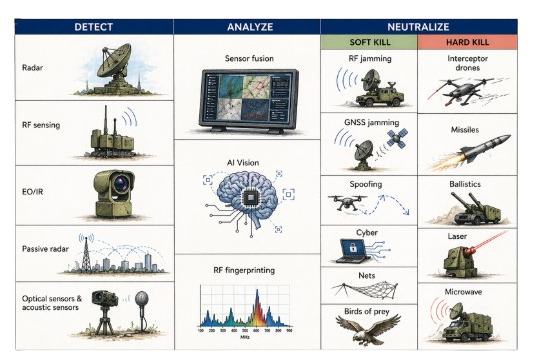
Average use of technologies across detection, analysis, and neutralization in CUAS systems
5. The next frontier of counter-drone warfare
As drone technology evolves, new challenges continue to emerge that complicate countermeasure. These challenges span a wide range of areas, from advanced drone types like biomimetic and high-speed drones, to spectrum dominance, data management, and mobile defense systems:
- Swarm tactics and adaptive behavior: While fully autonomous swarms are still under development, coordinated drone attacks have been used to overwhelm defense systems. In May 2025, Russia launched 273 Shahed drones in a single wave, with waves of over 400 drones reported later, saturating Ukraine’s defenses. These swarms exploit volume over precision, bypassing radar and forcing costly countermeasures. In recent months, Russia’s use of coordinated multi-drone tactics has tripled successful strikes, highlighting how sheer numbers increase operational effectiveness. The challenge for defenders is responding to high volumes of low-cost drones without relying solely on expensive interceptors, which are unsustainable at scale
- High-speed drones: High‑speed UAVs compress engagement windows and strain air defenses because they close distance rapidly and can execute unpredictable maneuvers. Many armed drones in active conflicts cruise at 200–250 km/h (~125–155 mph), speeds that significantly reduce detection and interception time compared with slower reconnaissance drones. For example, the Yemeni Houthi Samad family of attack drones routinely flies at these speeds over long ranges (>1,000 km), enabling them to strike deep into Saudi Arabia, Israel, and the UAE from Yemeni launch points, and forcing multilayered responses from Patriot and short‑range systems. Emerging jet‑powered drones could be 3–4× faster than piston‑powered models, shrinking defender reaction windows even further and approaching speeds where they resemble low‑end cruise missiles in engagement profiles. Quantitatively, higher speeds mean air defenses must detect and engage threats earlier and farther out, reducing the available time from minutes to tens of seconds at typical engagement ranges, and often require interceptors with both the speed and agility to match or exceed the incoming threat, increasing costs and complexity relative to the relatively low cost of the attacking UAVs.As example, ALM Meca is a company based in Alsace that specializes in the development of high-performance drones, including those designed for rapid response and high-speed engagements. Their drones are engineered to operate at speeds of up to 300 km/h (186 mph), which significantly enhances their ability to cover large areas quickly, making them ideal for time-sensitive missions. These drones are equipped with advanced propulsion systems and aerodynamic designs to achieve superior speed and maneuverability, enabling them to close the gap between detection and interception rapidly
- Biomimetic and stealth drones: Biomimetic drones, designed to mimic the flight patterns of birds, feature low radar cross-sections (0.01–0.1 m²), making them difficult to detect by traditional radar systems. Chinese-developed ornithopter drones, resembling birds such as magpies and hawks, have wingspans up to 2 meters and are capable of 90+ minutes of flight. These drones are particularly effective in urban and natural environments, where their ability to blend into surrounding wildlife and environmental clutter makes them hard to track. The lightweight design (<2.5 kg) and low cost (around $2,000–$5,000 per unit) further enhance their utility for covert surveillance and reconnaissance. In tests, these drones have successfully evaded detection during low-altitude flights (<150 meters), forcing defense systems to rely on multi-sensor fusion for detection. This growing capability highlights the need for advanced tracking and interception technologies to address the stealth and cost-effectiveness of biomimetic drones
- Electromagnetic and spectrum dominance: Achieving spectrum dominance is a major hurdle as drones increasingly use multiple communication channels, making signal disruption more complex. Effective countermeasures must selectively target drone communications while avoiding interference with civilian or military infrastructure. Ukraine’s use of the Bukovel‑AD system, capable of jamming GPS and GNSS signals over 100 km and targeting control links up to 20 km, highlights the role of electronic warfare (EW) in counter-drone operations. However, adversaries like Russia have adapted, deploying fiber-optic controlled drones that bypass RF jamming, forcing defenders to rely on optical sensors or kinetic interceptors. As drone technology evolves, the need for AI‑driven, multi‑band EW systems that can rapidly adapt to new frequencies and behaviors is becoming essential
- Rapid deployment and mobility: Static air defenses built to protect fixed sites are proving inadequate against mobile drone operations, which can launch from vans, trucks, and improvised platforms on short notice. In the Ukraine conflict, both sides deploy drones from vehicles and trailers, enabling dozens of daily sorties without fixed infrastructure and forcing defenders to reposition assets continuously to keep pace with mobile launch zones. This dynamic has spurred development of mobile counter‑drone systems that can be rapidly emplaced, networked and relocated, from vehicle‑mounted EW/jamming suites to integrated sensor/countermeasure packs that can be set up in minutes rather than hours. For example, the UK’s Project Volley is developing van‑mounted launch platforms capable of deploying 5+ drones in ~4 minutes at up to 200 km/h, reflecting lessons from recent Ukrainian operations where mobility underpinned both offensive and defensive drone use. Mobile solutions increase flexibility on dynamic battlefields by allowing defenders to shift EW, sensors, and interceptors to emerging threat vectors and reduce reliance on fixed installations, critical when adversaries exploit fluid frontlines and dispersed launch tactics.
- Psychological and strategic impact: Drone attacks disrupt more than just physical infrastructure; they create psychological and strategic instability. For example, the 2019 Houthi drone attack on Saudi Arabia’s oil facilities took 5.7 million barrels per day offline, causing oil price spikes and economic instability. In 2026, Iran’s drone strikes on the UAE, including over 2,000 drones intercepted, targeted energy and communications infrastructure, causing fires and further regional insecurity. These attacks not only damage but instill fear, forcing businesses and governments to reconsider security investments and risk exposure. The strategic impact includes market disruptions and civilian unrest, with long-term effects on regional stability
- Data and sovereignty issues: As drones evolve, real-time data sharing between nations, agencies, and private entities becomes crucial for tracking and neutralizing threats. However, this raises sovereignty concerns, particularly over sensitive defense data. Ukraine’s use of platforms like Palantir to analyze Russian drone operations has improved response times but also risks exposing data to foreign powers. For instance, Switzerland discontinued Palantir use in 2026 due to concerns about foreign access to national defense data. This highlights the broader challenge of maintaining national control over defense data while collaborating internationally
6. A landscape structuring around operational reality
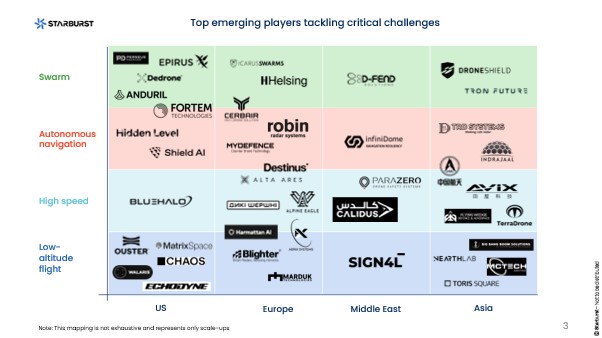
The counter-drone landscape is no longer emerging, it is starting to structure itself around a small number of critical operational challenges. Mapping the most active players reveals a market that is rapidly organizing not by geography, but by the physics of the threat: scale, autonomy, speed, and detectability.
First, the ecosystem is becoming problem-driven rather than technology-driven. Startups are no longer positioning themselves as generic “counter-drone” players, but are targeting very specific gaps, swarm neutralization, GNSS resilience, or low-altitude detection. This reflects a broader shift: the challenge is no longer to detect drones in isolation, but to manage complex, multi-dimensional threats.
Second, regional differences are shaping strategic positioning. Europe has built strong capabilities in detection and electronic warfare, aligned with a defensive posture and stricter regulatory environment. By contrast, US players are moving toward integrated, full-stack platforms, combining detection, tracking, and interception into scalable systems. Meanwhile, the Middle East is emerging as a fast adopter and operational testbed, driven by direct exposure to drone threats, and Asia is pushing ahead on hardware innovation, including high-speed and unconventional drone designs.
Third, the market is shifting from detection to engagement. For years, the focus was on identifying drones. Today, the bottleneck has moved: the real challenge is neutralizing large numbers of targets in real time. This explains the rise of solutions such as interceptor drones, directed energy systems, and high-power electromagnetic capabilities, all designed to operate at scale.
Finally, the market remains fragmented, but not for long. No single player today covers the full spectrum of capabilities. However, consolidation paths are becoming clear. Platform players, primarily in the US, are integrating multiple layers into unified systems, while specialized players (notably in Europe and Israel) are positioning themselves as critical building blocks within these architectures.
CONCLUSION
The rapid proliferation of drones is fundamentally reshaping modern warfare, introducing a new paradigm defined by scale, cost asymmetry, and technological agility. As demonstrated in recent conflicts, particularly in Ukraine, the widespread deployment of low-cost drones has exposed the limitations of traditional air defense systems, which were not designed to handle high-volume, low-signature threats.
Despite significant progress in counter-UAS technologies, no single solution currently provides a comprehensive answer to the diversity and complexity of drone threats. Soft-kill approaches such as jamming and spoofing remain essential but are increasingly challenged by autonomous and GNSS-denied systems. Conversely, hard-kill solutions, while effective, often suffer from unfavorable cost-exchange ratios and limited scalability when faced with mass drone deployments.
This evolving landscape underscores a critical shift: the challenge is no longer solely technological, but also economic and operational. The ability to counter drones at scale, in a cost-efficient manner, has become a central requirement for modern defense strategies. In this context, emerging technologies such as directed energy systems, high-power microwaves, and autonomous interceptor drones offer promising pathways to bridge the gap between effectiveness and scalability.
Ultimately, the future of counter-drone operations will rely on a multi-layered, system-of-systems approach, integrating advanced detection, AI-driven identification, and a mix of complementary neutralization capabilities. Equally important will be the ability to ensure interoperability, rapid deployment, and adaptability in dynamic environments.
As drone threats continue to evolve toward greater autonomy, speed, and coordination, the race between offense and defense will intensify. In this context, the actors that will prevail are those capable of combining technological innovation, industrial scalability, and strategic integration to build resilient and adaptive counter-UAS architectures.