One sky, two systems: What ATM and UTM must learn from each other

Abstract
Airspace is entering a new phase of complexity. The rapid growth of uncrewed aircraft, autonomous systems, and emerging air mobility is placing unprecedented demands on traffic management systems that were designed for a very different operating environment. Traditional Air Traffic Management (ATM) has been optimized for lower-volume, high-consequence operations, delivering exceptional safety through human oversight, procedural rigor, and mature governance. Unmanned Traffic Management (UTM), by contrast, has been developed to handle high-volume, low-altitude, and dynamic operations through digital-native architectures, automation, and scalable coordination.
Rather than competing approaches, ATM and UTM represent two complementary sets of best practices shaped by different constraints. ATM brings safety culture, accountability, certification discipline, and international interoperability. UTM contributes automation, real-time data exchange, and the ability to scale efficiently as traffic density increases. Neither model is sufficient on its own. Safe scalability will depend on how effectively these strengths are combined.
This article argues that the future of airspace will be defined not by disruption, but by selective inheritance. As uncrewed traffic scales, ATM-grade governance and operational discipline must be preserved. At the same time, UTM-grade automation and digital coordination must increasingly inform how all air traffic is managed, including crewed aviation. The transition will be gradual, moving from coexistence to coordination, and ultimately toward deeper integration based on mission profile and risk.
Startups and innovators play a critical enabling role in this journey by accelerating experimentation and translating operational needs into deployable digital capabilities, provided they remain closely aligned with regulators and ANSPs. Some ecosystems are already demonstrating this approach in practice. Singapore, under the guidance of the Civil Aviation Authority of Singapore, offers a reference model that pairs strong governance with pragmatic experimentation.
What makes this transition difficult is that ATM and UTM were never designed to meet in the middle. One optimizes for certainty, the other for scale. One privileges procedural stability, the other continuous adaptation. As traffic volumes increase and operational boundaries blur, these differences are no longer theoretical, they become operational constraints.
The central message is clear. There is only one sky. Its future will depend on the aviation community’s ability to combine the proven strengths of ATM with the scalable capabilities of UTM, and to do so deliberately, safely, and collaboratively.
-
The Sky Is Changing
Airspace management is entering a structural transition. Traditional Air Traffic Management (ATM) was designed for a stable environment defined by crewed aircraft, limited traffic density, and safety ensured through human oversight, standardized procedures, and mature governance [1]. This model has delivered exceptional safety, but it was not built for the traffic patterns now emerging at low altitude.
The industry is effectively managing one continuous airspace through two fundamentally different operating logics: a human-centric, procedural system optimized for low-volume certainty, and a digital, system-centric model designed for high-volume adaptability.
The scale of change is already tangible. In the United States, the Federal Aviation Administration reports more than 800,000 registered drones and close to 500,000 certificated remote pilots as of late 2025 [2]. This is not a future projection, but an existing population of airspace users. Even with conservative assumptions on simultaneous operations, this volume challenges systems optimized for low traffic density and manual control.
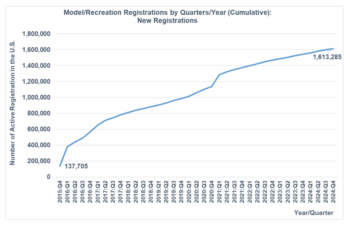
Credit: FAA Aerospace Forecast Fiscal Years 2025–2045
This evolution explains the emergence of Unmanned Traffic Management as a distinct operational concept. ATM manages low-volume in comparison with potential drone movements, high-consequence operations through human-centric control and procedural predictability. That approach does not scale high-density, autonomous, and low-altitude operations. UTM addresses a different problem set. It relies on digital coordination, automation, and system-to-system interaction to manage large numbers of aircraft through shared data and real-time decision support [3].
International institutions have formalized this distinction. The International Civil Aviation Organization defines UTM as a framework that enables unmanned operations while preserving the safety of manned aviation, with a strong focus on harmonization and interoperability [4]. In Europe, EUROCONTROL and European Union Aviation Safety Agency describe U-space as highly automated digital services designed to support large-scale drone operations, with explicit interfaces to conventional air traffic control [5] [6].
The result today is a sky managed by two parallel systems. ATM governs controlled airspace and crewed aviation, while UTM and U-space manage low-altitude uncrewed operations. This separation has enabled early innovation, but it has limits. As operations scale, interactions increase at airports, emergency airspace, temporary restrictions, and future eVTOL corridors. Airspace is continuous, even if management systems are not [7].
The challenge ahead is therefore not replacement, but coexistence with intent. In the short term, this means clear interfaces and shared situational awareness. In the longer term, it means convergence toward airspace management based on mission profile and risk, rather than on whether an aircraft is crewed or uncrewed.
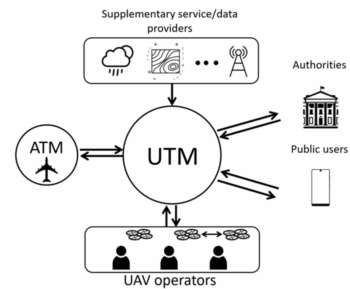
Credit: Vinogradov, Evgenii & Minucci, Franco & Pollin, S.. (2020). Wireless Communication for Safe UAVs: From Long-Range Deconfliction to Short-Range Collision Avoidance
The sky is changing because the demands placed on it have changed. How ATM and UTM respond together will determine whether aviation remains both safe and scalable.
-
Strengths of Each: A Best Practices Exchange
What to Keep, What to Add, What Must Evolve
KEEP – FROM TRADITIONAL ATM
These elements are foundational. They ensure trust, predictability, and safety, and must remain central as airspace scales.
- Embedded safety culture and conservative decision-making
Safety is treated as a system-wide responsibility, not a feature. Decisions are intentionally conservative, with margins designed to absorb uncertainty and failure without cascading risk [1].
- Clear accountability and liability frameworks
Roles and responsibilities are unambiguous across operators, service providers, and authorities. This clarity underpins trust, compliance, and effective incident management [8].
- Rigorous certification and structured change management
Systems, procedures, and personnel are certified through formal processes. Changes are introduced incrementally, supported by safety assessments and operational validation before deployment.
- International interoperability under ICAO standards
Harmonized rules and procedures enable seamless cross-border operations and consistent safety expectations, even as traffic moves between jurisdictions [9].
ADD – FROM UTM
These practices are essential to handle volume, diversity, and speed without compromising safety.
- Automation and rule-based coordination
Routine decisions such as conflict detection, separation, and constraint management are handled automatically, reducing human workload and enabling consistent responses at scale.
- Digital-native, system-to-system communication
Coordination relies on structured data exchange rather than voice communication, enabling real-time interaction between operators, platforms, and authorities.
- Real-time data sharing and situational awareness
All relevant actors access a common operational picture, integrating traffic intent, constraints, and environmental data to support timely and informed decisions.
- Low marginal cost per additional operation
Software-driven coordination allows traffic volumes to increase without a proportional increase in human resources, making large-scale operations economically viable.
EVOLVE – THE HUMAN ROLE
Human expertise remains critical, but its focus must shift as automation increases.
- From flight-by-flight control
Humans are no longer required to manage every individual movement or routine interaction.
- To supervision, exception handling, and orchestration
Humans oversee automated systems, intervene in abnormal or high-risk situations, and manage traffic flows at a strategic level, including prioritization and contingency response.
It is also important to acknowledge the progress made within the ATM community itself. While often perceived as slow-moving, the ATM industry has taken deliberate and meaningful steps to become more scalable and flexible. The development of concepts such as Trajectory-Based Operations (TBO) and Flight and Flow Information for a Collaborative Environment (FF-ICE) reflects a clear shift toward data-driven, network-centric operations. These initiatives aim to improve predictability, enable earlier and more collaborative decision-making, and reduce reliance on tactical interventions. They demonstrate that ATM is not static, but evolving in ways that align with many of the principles underpinning UTM, including increased automation, shared information, and system-wide optimization, under frameworks promoted by the International Civil Aviation Organization.
But safe scalability will not come from replacing ATM with UTM. It will come from preserving ATM-grade safety, governance, and accountability, adding UTM-grade automation and digital coordination, and evolving the human role to match a more complex and automated airspace.
Without ATM-grade accountability, liability becomes unclear and trust erodes. Without UTM-grade automation, human workload grows faster than safety margins. Without evolution of the human role, automation becomes brittle and prone to unsafe workarounds.
-
The Role of Startups and Innovation
Scaling airspace safely is not only a regulatory challenge. It is also an innovation challenge. Traditional ATM organizations bring unmatched experience in safety and governance, but their modernization cycles are long and constrained by legacy systems. Startups play a critical role by accelerating capability development where speed, flexibility, and experimentation are required.

The AirBridge platform is a comprehensive, adaptable and modular unmanned traffic management platform that will enable the integration of AAM and drone operations amongst stakeholders and across differing landscapes. Heron AirBridge Image
Why legacy modernization alone is not enough
- ATM systems are designed for stability and assurance, not rapid iteration
- Certification, procurement, and deployment cycles often span multiple years
- New operational demands such as BVLOS, autonomous operations, and dense low-altitude traffic evolve faster than traditional upgrade paths
Without additional innovation capacity, a gap emerges between operational needs and available capabilities.
What startups contribute
- Speed of prototyping and testing
Rapid validation of concepts such as automated deconfliction, digital flight authorization, and dynamic constraint management. - Digital-native expertise
Strong capabilities in cloud computing, automation, connectivity, and AI, which are essential for managing traffic at scale. - Use-case-driven design
Solutions built around concrete operational needs, including logistics corridors, infrastructure inspection, and emergency response. - New service and delivery models
Software-based platforms and shared infrastructure that reduce the marginal cost of additional operations.
In practice, startups contribute at specific system touchpoints, including digital flight authorization, real-time constraint and airspace status management, traffic intent exchange between operators, and software interfaces linking operators, regulators, and ANSPs.
What startups cannot do alone
- Define airspace rules or safety objectives
- Replace regulators or ANSPs
- Establish trust without institutional backing
Innovation delivers the most value when startups are embedded alongside regulators and ANSPs, through joint trials, early alignment with certification and safety requirements, and continuous feedback from real operations. Interoperability is essential. No single platform will manage all airspace, and fragmented systems increase risk, making alignment with international frameworks led by the International Civil Aviation Organization critical. Startups are not disruptors of airspace governance. They are accelerators of capability, enabling ATM and UTM to evolve faster without compromising trust, accountability, or safety
-
The Road to Integration: A Phased Journey
The transition from today’s parallel systems to a unified airspace will not be immediate. It will follow a phased evolution, driven by traffic density, operational risk, and regulatory maturity. Each phase builds on the previous one, reducing fragmentation while preserving safety.
It is important to distinguish between the integration of airspace and the integration of traffic management systems. Airspace integration concerns how different types of aircraft safely share the same physical environment. ATM–UTM integration, by contrast, refers to how services, systems, data, and responsibilities interact to support those operations. While related, these two dimensions do not evolve at the same pace. In practice, management systems can become increasingly coordinated and interoperable even when airspace access rules remain segmented or risk-based.
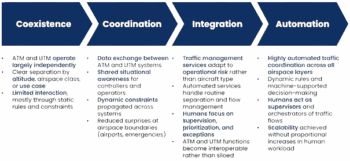
Progression between phases is typically triggered by traffic density, interaction frequency, and risk exposure. Delaying transition increases fragmentation and inefficiency, while premature integration risks undermining safety, trust, and operational credibility.
Phase 1 – Coexistence
Where we are today
This is largely where the industry operates today. ATM and UTM systems function in parallel, serving different users and airspace segments. Separation is achieved through altitude limits, airspace classes, or mission-specific rules. This approach has enabled early innovation in uncrewed aviation while protecting the integrity of traditional air traffic operations. Coexistence provides clarity and reduces complexity in the short term, but it relies heavily on segregation and static assumptions. As traffic volumes increase and operational profiles diversify, this model begins to show its limits.
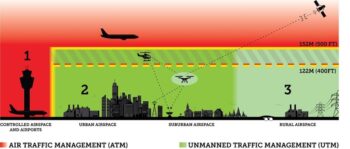
Credit: A Decentralized Solution for Integrating Large-Scale UAS Operations into Future Aviation Systems
Phase 2 – Coordination
Shared awareness, separate control
As interactions multiply, the system naturally moves toward coordination. In this phase, ATM and UTM remain distinct, but no longer isolated. Data flows between systems, creating shared situational awareness across stakeholders. Airspace constraints, traffic intent, and operational restrictions are exchanged in near real time, reducing surprises at critical interfaces such as airports, emergency zones, or temporary restricted areas. Control remains separate, but decisions are increasingly informed by a common operational picture, improving predictability and resilience
Phase 3 – Integration
Services based on mission and risk
Integration marks a more fundamental shift. Traffic management services are no longer defined primarily by aircraft type, but by mission profile and risk level. Automated functions handle routine tasks such as separation, sequencing, and constraint management, while human operators focus on supervision, prioritization, and complex or abnormal situations. ATM and UTM functions become interoperable rather than siloed, enabling smoother transitions across airspace layers and use cases. This phase represents the move from coordination to functional convergence.
Phase 4 – Automation
Human oversight, machine execution
At higher levels of maturity, the system evolves toward increased automation. Coordination across airspace layers becomes largely automated, supported by dynamic rules and machine-assisted decision-making. Humans remain firmly in the loop, but their role changes. Rather than managing individual movements, they supervise automated systems, manage exceptions, and orchestrate traffic flows at a strategic level. Automation, in this context, is not a substitute for safety, but a prerequisite for maintaining it at scale
A controlled progression
Across all phases, several trends remain constant. Human roles evolve from tactical control toward supervision and orchestration. Rules shift from static segregation to dynamic, risk-based management. Systems move from isolated platforms to interoperable services. Governance progressively aligns toward international frameworks led by the International Civil Aviation Organization, ensuring consistency as traffic increasingly crosses borders.
The key insight is that integration is not a single milestone, but a managed progression. Moving too slowly risks fragmentation and inefficiency. Moving too quickly risks eroding trust and safety. The challenge for regulators, operators, and innovators alike is to advance deliberately, aligning technology, regulation, and operations at each stage of the journey.
-
Conclusion: One Sky, One Future
The transformation of airspace is no longer theoretical. Uncrewed aircraft, autonomous systems, and emerging air mobility are already reshaping how the sky is used. The question facing the aviation community is not whether these systems will coexist with traditional aviation, but how deliberately and coherently that coexistence is managed.
ATM and UTM were designed for different constraints, but they are now converging toward the same operational reality. ATM brings decades of safety culture, governance, accountability, and international interoperability. UTM brings automation, digital coordination, and the ability to scale with demand. Treating these systems as competing models would be a mistake. Safe scalability depends on combining their strengths, not replacing one with the other.
The path forward is incremental. Coexistence gives way to coordination, coordination to integration, and integration to higher levels of automation. At each stage, the objective remains the same: preserve safety and trust while enabling new operations. Moving too slowly risks fragmentation and inefficiency. Moving too fast risks undermining the very foundations of aviation safety. The challenge is to progress deliberately, aligning technology, regulation, and operations at every step.
Organizations operating at the intersection of regulation, operations, and innovation carry a responsibility to translate between these domains, ensuring that new capabilities are operationally credible, certifiable, and trusted. Progress depends less on disruption than on disciplined collaboration.
Early movers are already shaping this future. Ecosystems that combine strong regulatory leadership, operational realism, and openness to innovation are setting benchmarks others will follow. Singapore is one such example. Through the guidance of the Civil Aviation Authority of Singapore, the focus has been less on disruption and more on credible, scalable integration, pairing experimentation with strong governance [12]. These approaches matter, because decisions taken today will influence international norms for mixed-traffic airspace tomorrow.
The central message is simple. There is only one sky. Fragmentation increases risk, while integration creates resilience. By preserving ATM-grade safety and governance, adopting UTM-grade automation and digital coordination, and evolving the human role accordingly, the aviation community can build an airspace system that is both safe by design and scalable by necessity.
The future of flight will be defined not by what flies, but by how we choose to manage the airspace they share.
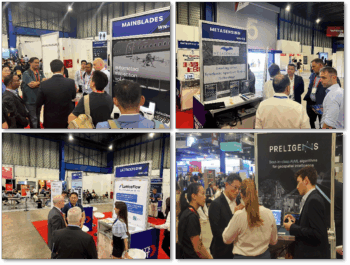
At Starburst, we work at the intersection of these worlds. Our role is to help startups, corporates, ANSPs, and public authorities navigate this transition together, translating emerging technologies into operationally credible solutions and aligning innovation with real regulatory and safety constraints. As airspace management evolves toward coexistence and integration, building the right partnerships early is critical. We believe progress happens when innovators and institutions engage openly, pragmatically, and with a shared understanding of operational realities. At the Singapore Airshow, we will be animating the Innovation Zone and would be pleased to exchange in person with stakeholders navigating these challenges.
Sources
[1] ICAO – Annexes to the Chicago Convention (ATM, Safety Management)
[2] FAA – UAS by the Numbers, 2025
[3] FAA – Aerospace Forecast FY 2025–2045
[4] ICAO – UTM Framework, Edition 4
[5] EUROCONTROL – U-space Concept of Operations & ATM Interface
[6] EASA – U-space Regulation and ConOps
[7] ICAO – UAS–ATM Integration and Fragmentation Risk Guidance
[8] ICAO – Safety Management Manual (SMM)
[9] ICAO – Global Air Navigation Plan (GANP)
[12] CAAS – Singapore UAS and AAM Regulatory Frameworks